

Note: Until the end of July, I’m offering paid annual subscriptions at 50% off the regular rate. You can redeem that offer here, and I hope you’ll consider supporting my work if you can.
A version of the following was originally published in Jacobin in 2023.
Having reportedly made six-figure profits on the first offering last year, Donald Trump has just released a new round of non-fungible tokens (NFTs). On an aesthetic level, the images are strangely fascinating in their gaudiness. In one, the former president is shown as George Washington crossing the Delaware. In another, he is clad in leather and hoisting an electric guitar. In a another, he is wearing camo while brandishing a crossbow and binoculars in front of a blurrily rendered forest.
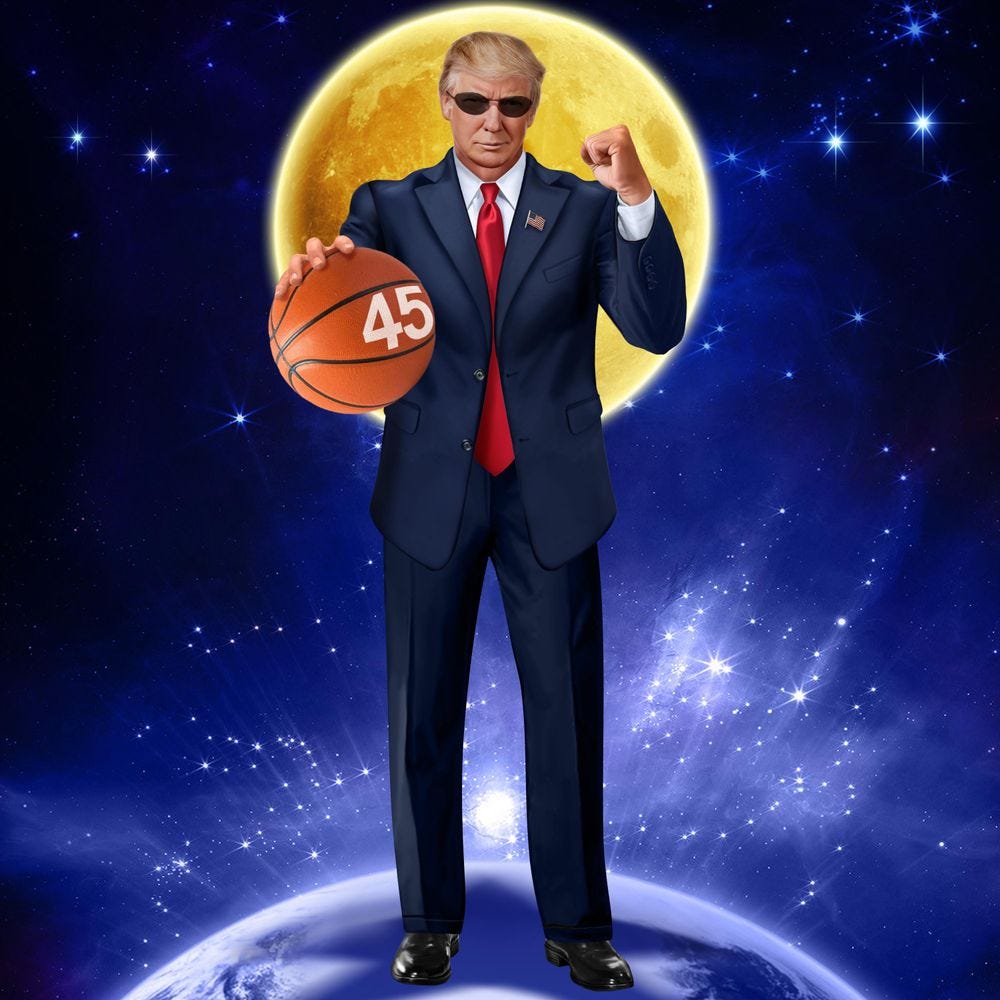
Like the earlier Trump-themed NFTs, the latest batch is audaciously artificial in appearance, assembled from bland stock images and channeling a kitsch iconography of Americana, money, and machismo. Their constituent parts, recycled again and again across dozens of different NFTs, have all the elegance of Windows 98–era clip art, and some (like this one showing Trump standing in space wearing sunglasses with a basketball in hand) don’t even conceptually make sense.
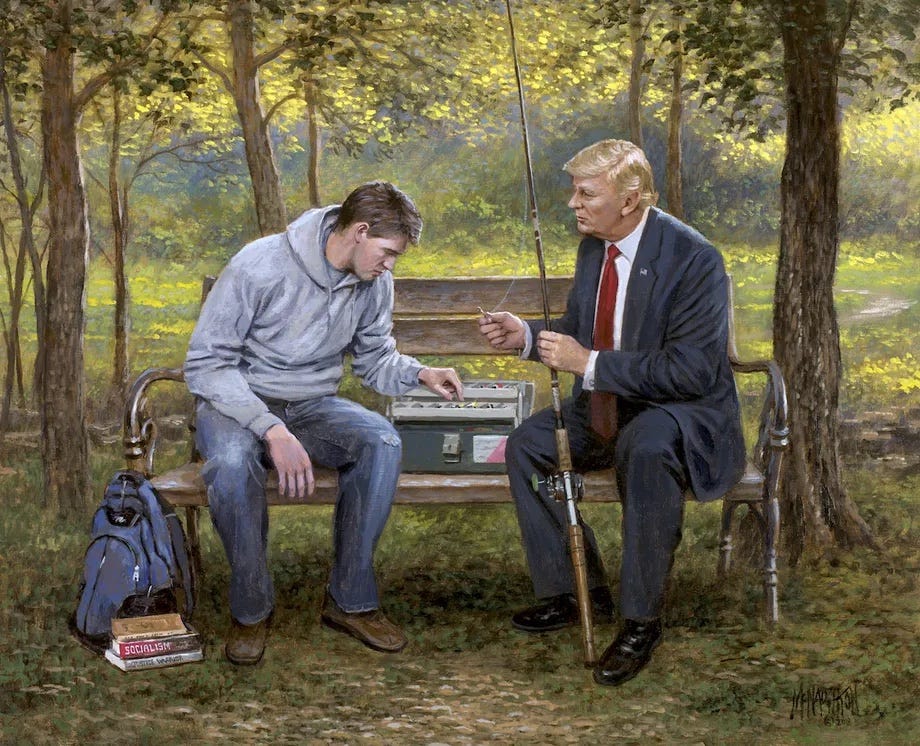
Aesthetically-speaking, the collection reflects a low-rent version of the burlesque pastiche that has become the house style of Trump-era conservatism. This peculiar genre of reactionary art fuses the idioms of a lachrymose American nationalism with the cheap superficiality of a late-night infomercial or motivational seminar. Best represented by the work of painter Jon McNaughton, it yields images that are at once insipid in form and grandiose in ambition. In Trump’s NFTs, the style has finally reached its apex as a kind of algorithmically generated, dadaist folk art that effectively transcends conventional value judgments like ugliness, truth, and beauty.
For the low, low price of roughly a hundred dollars, you can now buy an ersatz likeness of America’s forty-fifth president that cannot physically exist outside the digital ether. Even for Trump, a man whose entire life has revolved around an endless series of bullshit scams, it takes remarkable chutzpah to put a price tag on something so obviously useless — especially in 2023, after the NFT bubble has already burst.
Both Trump’s embrace of the medium and his timing, however, make the whole thing a perfect marriage. Just like Trump’s career, the crypto/NFT boom was a giant confidence trick that rode a wave of bloated perceptions and sleazy hype before finally leaving a trail of human misery in its wake. Speculative virtual commodities are the proverbial ripping-the-copper-wiring-out-of-the-walls stage of American capitalism, an effort at predatory rent seeking with zero pretence to either social or use value. Whatever legitimacy they briefly enjoyed was mostly owed to liberal celebrities paid truckloads of money to hawk Bored Ape gifs on social media and promote them on late-night TV. Thin as this was, it successfully lent the crypto-NFT racket a momentary sheen of chic and glitz.
It follows that someone like Trump would get in on the action only after this initial buzz had dissipated. Throughout his career, Trump has taken the foundational myths of American capitalism — American exceptionalism, free enterprise, the self-made billionaire — and performed them as a vulgar pantomime shorn of subtext. He is a man more famous for playing a successful real estate tycoon than actually being one; a politician who projects the basest cruelties of the conservative psyche without any of the traditional appeals to unity, civility, or moral integrity.
If NFTs are capitalism stripped to its barest transactional elements in a gilded era of Big Tech dominance and monetized selfhood, Trumpism represents the distillation of American culture and politics into an ethos of pure grift and boundless commodification. Through Trump’s rhetoric and speech patterns, we have come to know what this sounds like. Thanks to his NFTs, we now have a howlingly bleak portrait of what it looks like as well.
Not incidentally, the only real flashes of authenticity in Trump’s 1987 bestseller The Art of the Deal come through his lavish (and sometimes quite tender) descriptions of physical surfaces. For Trump, life has always been about perceptions and appearances rather than depth or substance. As both a businessman and a politician, this has seen him innovate a whole new language of exaggeration and hyperbole into being. “The point is that we got a lot of attention,” he writes in Art of the Deal of a never-fulfilled promise to build the world’s tallest building that could also double as an operating principle for politics and culture today, “and that alone creates value.”