

Note: You can listen to my full conversation with Avi Lewis, the new leader of Canada’s NDP, here. Until April 1st, I’m also offering annual subscriptions at 50% off the regular rate. There’s never been a better time to subscribe, and you can redeem the offer by clicking this link.
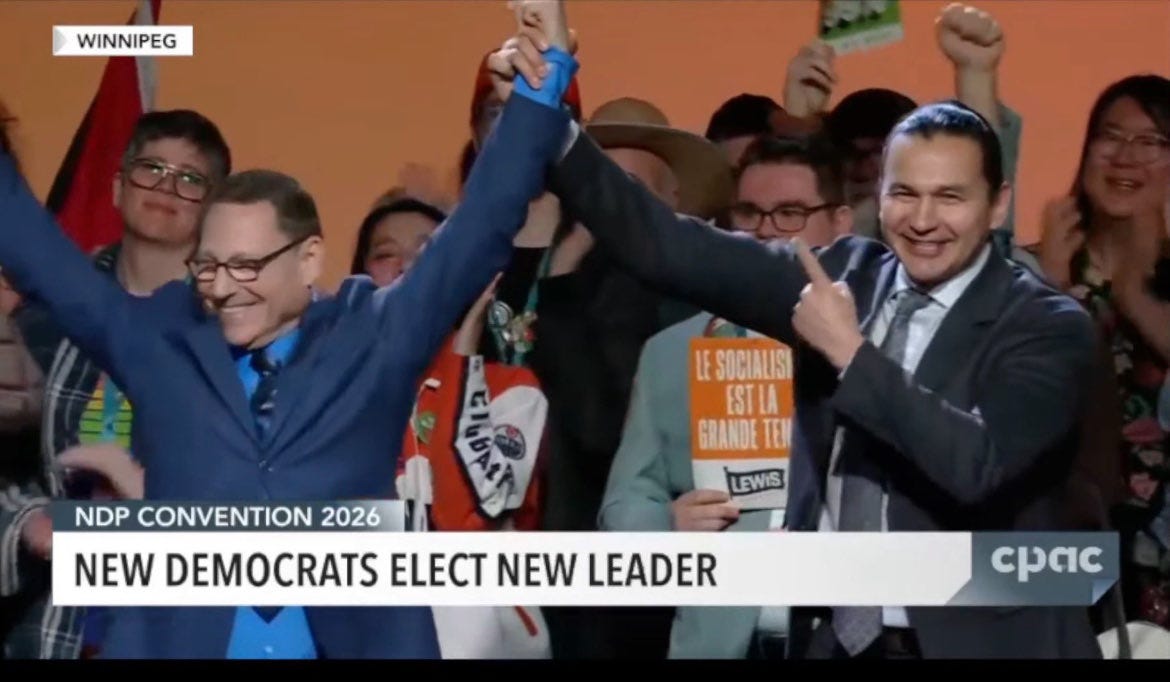
On Sunday, Canada’s New Democratic Party officially elected its new leader in Winnipeg. There is plenty to say about the result. But first, a story.
I attended my first NDP convention in the summer of 2009, just after starting university. It was a memorable experience, and I met many people there I still know today. Held in beautiful Halifax while the late Jack Layton was leader, some of the seeds of the party’s 2011 electoral breakthrough were already visible. I was then very young and inexperienced in politics, but I also had an at least murky awareness that some of the fault lines in Canadian social democracy were visible too.
The NDP, as is true for any party bigger than a sect, has always had different tendencies and factions residing inside its tent. Because of Canada’s size and the complexities of its federal structure, some of these are regional. Thanks to the party’s origins in the merger of its predecessor (the Co-Operative Commonwealth Federation or CCF) and the Canadian Labour Congress, its internal politics are to some extent shaped by those of the labour movement as well.
But there is also a deeper, more existential divide when it comes to the NDP’s modern identity, and flashes of it were evident to my younger self some 17 years ago in Halifax. On the rostrum that week were MPs and labour firebrands like Leo Gerard of the United Steelworkers (who among other things got a round of applause by reminding the room that Conrad Black was still in prison). One of the convention’s keynote speakers, on the other hand, was a senior operations staffer from the recent Obama campaign, while one of the convention’s most discussed resolutions (not passed, for what it’s worth) proposed to drop the word “new” from the party’s name altogether in an apparent nod to the party of Obama and Clinton.
The remarks delivered by former leader Ed Broadbent and the newly-minted NDP premier of Nova Scotia Darrell Dexter in particular underscored two radically different ideas of what the party is and how it should orient itself. Both, as Bryan Evans writes in the 2012 book Social Democracy After the Cold War, suggested there was something “Janus-like” about the NDP and its identity. On this point, Evans is worth quoting at some length:
Broadbent delivered the convention’s opening keynote speech; it was the first time he had spoken to a party convention since resigning as leader in 1989. Indeed, in historical terms, the convention was taking place at the height of the Great Recession, when there appeared to be a global deathbed conversion to old-style Keynesianism. Broadbent noted that we were living in a “social democratic moment” where “even governments of the right . . . have now had to adopt the kinds of policies we social democrats have advocated all along.” The theme of his address was the importance of state intervention to stabilize the market economy and to promote greater equality through redistribution of resources and opportunities. Canada’s postwar welfare state had contributed significantly to this goal through concrete policies and programs that Broadbent succinctly summed up as “government pensions, universal health care, trade union rights, comprehensive unemployment insurance, the expectation that every boy and girl with ability could go to university,” all contributing to a state in which, ideally, “all were paid for by adequate levels of progressive taxation.” But he lamented that three decades of neoliberalism (he did not use this term) had effectively eroded this social democracy through tax cuts and an increasingly regressive taxation regime, and the termination of redistributive programs — all of this resulting in expanding inequality. In closing, Broadbent identified his party’s task: “to demonstrate, show and persuade Canadians that with more equality” a more civil, productive, socially cohesive, and healthier Canada was possible. In other words, he exhorted his party to advocate for the social democracy of redistribution, a mixed economy, and an effectively regulated market.
This was vintage Ed Broadbent as I later came to know him. It was hardly the radical stuff you might find in his speeches from the 1960s and 70s. But in both content and style, it still reflected an idea of the NDP that was consciously grounded in the values and objectives of social democracy — envisioning a party guided by an explicit critique of the established order and anchored in an alternative social vision of its own. Dexter, who had just made history as his province’s first NDP premier, gave a rather different kind of speech. Here’s Evans again:
In contrast, the new premier of Nova Scotia, the head of the first New Democratic government in Atlantic Canada, presented a different narrative. The day after Broadbent delivered his impassioned denunciation of inequality and market fetishism, Dexter urged the party to “not be shackled by the past” and to “embrace a wider set of values,” adding that the NDP is a “new modern political party” that needs to become a “big tent.” But the delegates at the convention were not completely convinced to follow Dexter’s advice: resolutions calling for tax credits for small and medium-sized businesses, similar to a Dexter-government policy, and a proposed renaming of the party, met such strong opposition that they did not make it to the convention floor.
I’ve since visited Nova Scotia several more times, though I can’t pretend to be an expert on the record of its only NDP government. What I can say — having volunteered on quite a few campaigns, worked as both a federal and provincial staffer, and run as a candidate for the Ontario NDP — is that there was more a stake in the contrast between Broadbent’s speech and Dexter’s than I appreciated at the time.
Now, to the race.
To first state the obvious, Avi Lewis’s victory in Winnipeg was resounding and decisive. Given both the campaign’s fundraising numbers and the sizeable crowds turning out at Lewis’s events, I was not exactly surprised (on Saturday, in fact, a left wing slate’s sweep of the NDP’s federal executive offered an even stronger hint of what lay in store). Still, the scale of Lewis’s victory was considerable — and, as someone who has been quite public about my own preferences, I am very pleased with the result.
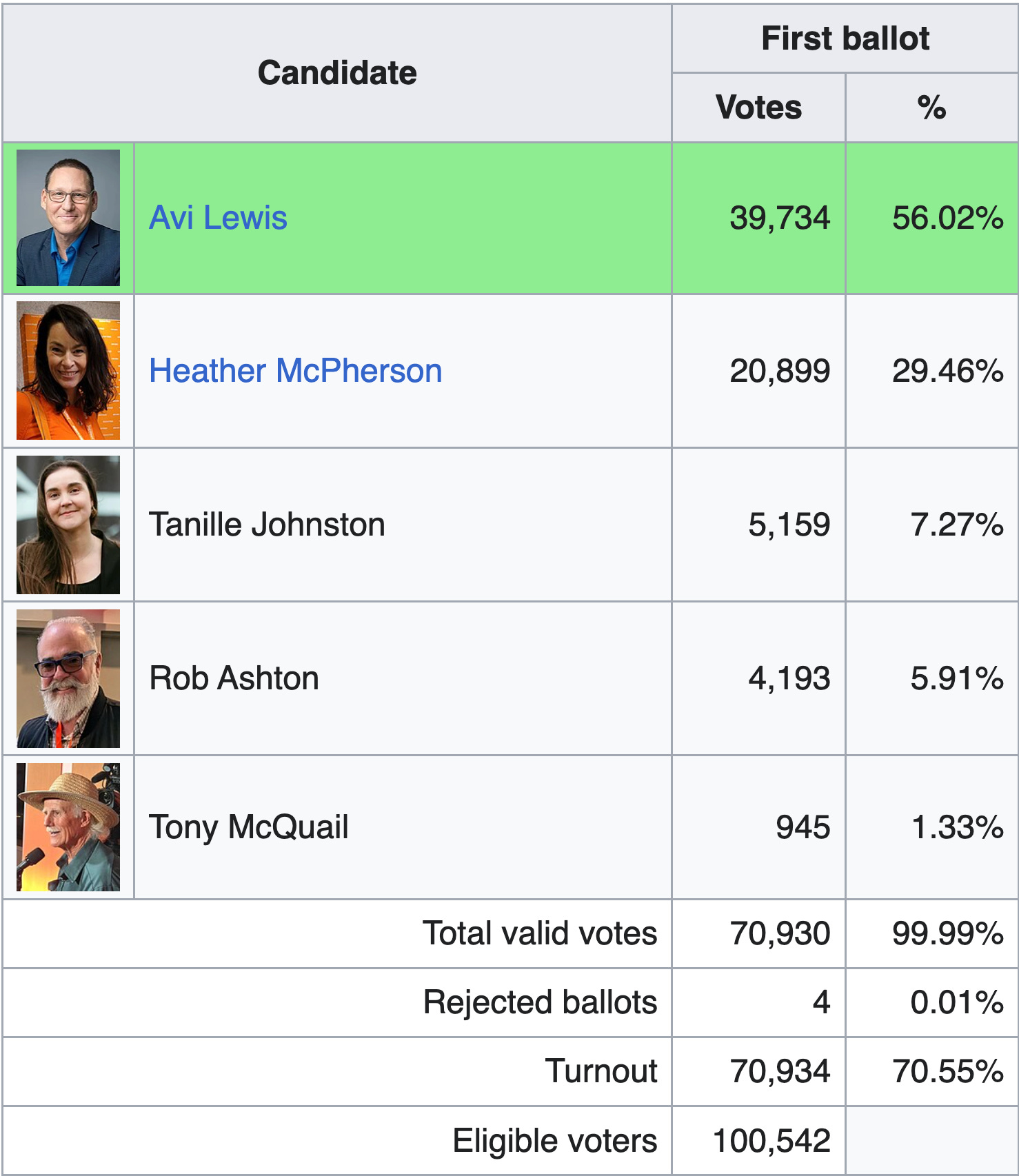
Regarding the vote tally, a few specific points are worth making. First, with just under 80,000 electors participating, 2026 marks the largest voting electorate in the history of an NDP leadership race (surpassing 2017 by a few thousand). In both percentage and raw numbers, Lewis’s victory sets a record also. At almost 40,000 total, he’s won more votes than any other NDP leadership candidate since the introduction of the party’s current one-member-one-vote system. When you add to this his record-breaking fundraising haul, you have the potential ingredients for the kind of political recovery the party so desperately needs.
Regarding the other candidates, a few supplemental points. The big question on the first ballot was whether the anti-Lewis vote would effectively consolidate around a single candidate or be split between MP Heather McPherson and union leader Rob Ashton. It ultimately did cohere around the former, but without sufficient numbers to force a second ballot. Ashton’s vote was lower than I think many expected, and here I’ll defer comment to Labour Studies professor Larry Savage (incidentally no relation). Tanille Johnston, a gifted organizer who narrowly lost her race in the BC riding of North Island-Powell River last year, deserves immense credit for finishing third, and Tony McQuail ends the race with the respect of everyone involved.
What exactly happens next is to some extent anyone’s guess.
Avi Lewis has won a landslide mandate but also takes the reins of a party burdened by debt, down to just six MPs, and still fresh off the worst result in its history. He himself will not have a seat until at least the next election (unless he changes his mind and decides to run in an upcoming by-election, though I think this is unlikely) and faced negative broadsides from the leaders of the Alberta and Saskatchewan wings of the NDP within minutes of being elected.1 Lewis’s approach, as he told me in February, has been to welcome open debate and disagreement — indeed, this is one of the reasons I endorsed him — while stressing points of commonality with figures like Alberta’s Naheed Nenshi (Nenshi in particular evidently has no intention of paying Lewis or the majority of NDP members throughout the country the same courtesy). The barrage from right wing talking heads and pundits is bound to ramp up as well and will only get shriller as Lewis’s national profile grows.
Weathering these attacks will take resolve and discipline, and the best defence will be a continuation of the populist strategy Lewis embraced to win the leadership. The electorate, by and large, does not love corporate monopolies, unaffordable housing, concentrated wealth, or high grocery prices. The Carney government, for the time being at least, remains very popular, though polls suggest a majority disapprove of its orientation in some areas — notably, the prime minister’s recent endorsement of the US-Israeli attack on Iran. Clearly, there is fertile terrain for a left populist alternative here and, for what it’s worth, I am optimistic that the NDP can gain seats and win back official party status after the next election. Only once this objective has been achieved can anyone begin to think again about the much more ambitious goal of forming government. Here, I stand by what I wrote last year for the Perspectives Journal and I think many of the obstacles and strategic challenges ahead will be familiar:
If the [NDP] hopes to rebuild on a national scale with the goal of eventually forming government, it will need to solve the strategic issues that have persistently thwarted even its most promising efforts to date. Broadly-speaking, these include (in no particular order): 1) the continued salience of the federalist/sovereigntist dynamic in Quebec and the obvious challenges this poses for a national social democratic party; 2) the continued, if sometimes provisional loyalty of many self-identified progressives and so-called “strategic voters” to the Liberals; 3) the party’s periodic inability to translate its often high levels of provincial support in Ontario and the West into a commensurate number of federal seats…In any case, it’s clear the NDP cannot effectively recover if its renewal is treated solely as a rebranding exercise. Breaking the logjam of two-party politics will require more than just effective leadership and good messaging. Fundamentally, it calls for a creative populist strategy as well: rooted in both the engaged participation of a mass membership and the kind of bold, left-wing program that is impossible for the Liberals to appropriate or co-opt.
Avi Lewis’s victory is significant in its scale, but is consequential in less strictly measurable ways too. Contrary to what some have insisted over the past six or seven months, the NDP’s leadership race really was about the party’s fundamental values and purpose rather than the more straightforward question of how it should communicate.
Beneath the race’s often irritating debates about political language, I think there lingered a somewhat deeper divide and, thankfully, the party’s left was able to convince a majority of NDP members of its case. To some, the idea of “meeting people where they’re at” has evidently come to mean never speaking or thinking in ideological terms at all. This, in turn, means conceiving of members and voters like passive consumers of political messaging rather than as active agents or participants in politics just waiting to be organized. It means invoking broad concepts like “fairness” and “compassion” and pitching vaguely-defined “solutions” rather than trying to meaningfully alter the contours of Canadian society. It means treating the NDP’s populist history as a heritage object rather than as a living tradition or source of inspiration.
All of which is to say, there is a potential for renewal here that goes beyond what might be tallied in membership signups and fundraising numbers. When Lewis and his team say they hope to make the party into a “political instrument of the people” there is every reason to think they really mean it. The state of the country, indeed the state of the world, clearly demands nothing less.
It’s worth noting that these reactions were atypical of the NDP’s provincial sections. The country’s most popular premier, Wab Kinew of Manitoba, appeared onstage with Lewis at the convention and enthusiastically endorsed his leadership in a media scrum following his speech.
social democrats should seek to democratize the party and align it around a comprehensive, ideologically coherent program at the maximum steady pace possible. corbyn is what happens when you lack the political will to do that.
with the provinces my gut reaction says marginalize the blairite bureaucracy’s influence amongst the r&f/quotidian operations and then dare them to split. hard balance to strike at the right time, but it’s necessary — again look at the price of failure.
it seems like the militarist/atlanticist center left european S&D parties (esp. SPD) have too much soft power in the NDP. find better role models (e.g. progintl) + social democrats who suck less (e.g. ireland, spain, norway).
It feels at this moment that "meeting people where they are at" (if taken literally) requires some bold willingness to say "things are pretty fucked and need to change completely". I am not sure you meant it this way but, to that end, "solutions" (to tangible immediate material challenges) are a way to talk about that, especially when those solutions expose and transcend the silly self-imposed restraints of capitalism.