

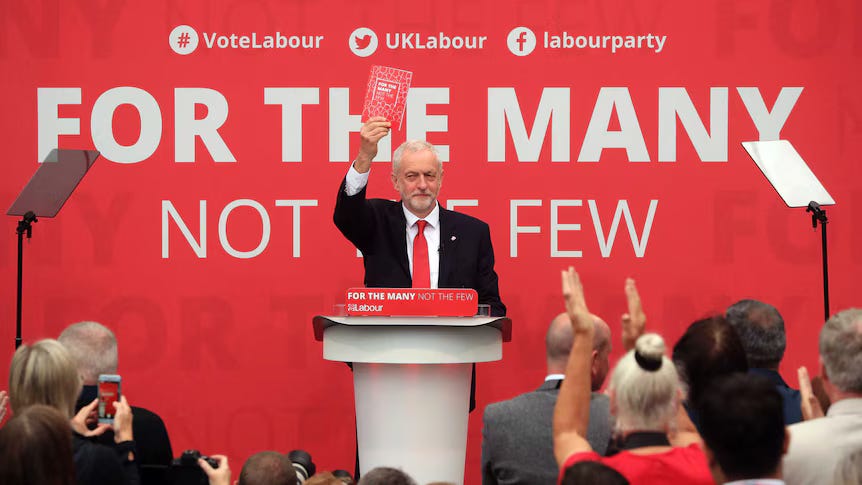
On a recent episode of the London Review of Books’ On Politics podcast, James Butler hosted a conversation about the current state of Britain’s Labour Party with Sienna Rodgers (deputy editor at the House magazine) and Jeremy Gilbert (a professor of cultural and political theory at the University of East London.) If you haven’t been following British politics lately, you might not be aware of how profoundly things are currently in flux. Less than two years after winning back government, the Labour Party seems on the precipice of electoral oblivion. Keir Starmer’s premiership is on life support, and will probably reach its ignominious end when Labour is hammered in local elections this spring. As I wrote recently, the Starmer project was supposed to be the ultimate vindication of centrist and centre right electoral theory and has instead yielded a government so existentially unpopular that it’s now an open question whether Labour will remain a major party at all.
The discussion between Butler, Rogers, and Gilbert gives a wonderful all-around picture of how Labour’s right has brought the entire party to the brink. But one exchange struck me in particular. A little under an hour into the conversation, Butler notes the existence of “a significant political faction [within the British electorate] that wants significant political change from the left.” Here, he’s referring to the sizeable chunk of millennials and other left-leaning demographics which the Labour Party had lost by the time of Gordon Brown’s defeat in the 2010 general election. During the 2010s, these people went on to be the backbone of tuition protests and anti-austerity demonstrations. Some of them probably supported the Liberal Democrats in 2010, though many were subsequently radicalized and went on to be the vanguard of Jeremy Corbyn’s stunning and improbable campaign for the Labour leadership in 2015. Today, needless to say, the overwhelming number have abandoned the Labour Party and shifted their allegiance to parties like the Greens. According to Gilbert, the number of left wing members who have departed or been expelled from Labour since Starmer took over is roughly 300,000 — an exodus that likely has few parallels in modern history.
Indeed, Gilbert observes that this group has ultimately turned out to be far, far bigger than consensus political wisdom understood, and asserts that roughly one-quarter of the British electorate has effectively been socialist in attitude since even before the 2010s. Mostly, however, it has not had any kind of political voice. It’s been largely ignored and unrepresented in the media, considered outside the mainstream of Britain’s major parties, and assumed to be more a minor fringe than a tendency worth taking seriously.
That changed when Corbyn won the Labour leadership, and I still remember the generalized bafflement that greeted his victory throughout most of Britain’s political and media elite. There was even greater bafflement at the results of the 2017 general election, which in every way defied the conventional wisdom of elite pundits and political strategists — and did so despite segments of the party’s own machinery being in more or less open revolt against its leader. Labour, tragically, did not win. But in all my years of following politics I don’t think I’ve ever felt more euphoric than on the night of June 8, 2017.
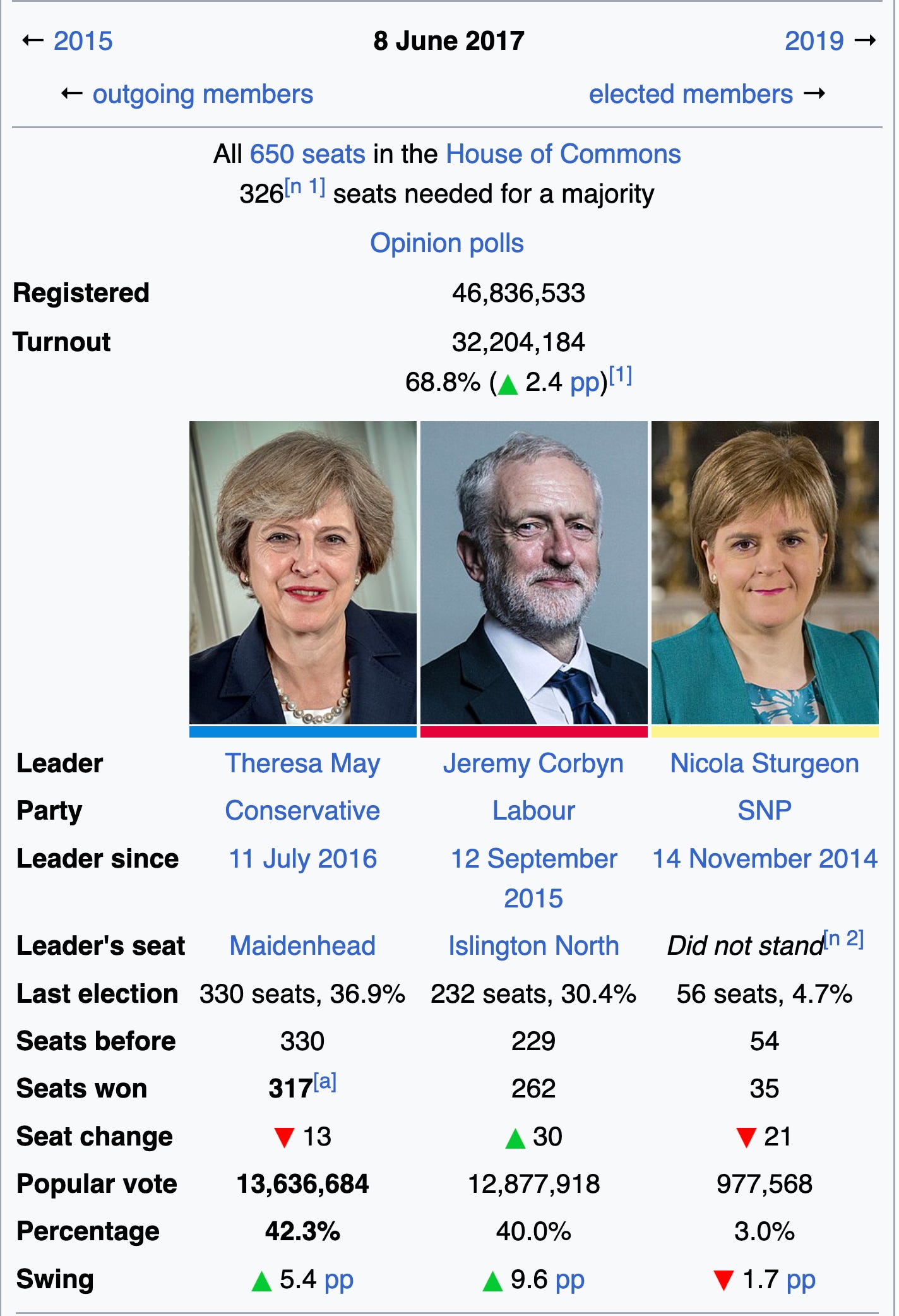
From its outset, the Corbyn project had been dismissed as irrelevant, dangerous, marginal and, above all else, doomed to be crushed by Theresa May. But 2017 ultimately produced a swing to Labour on a scale not seen since Clement Atlee’s 1945 landslide. Under more conventional electoral conditions — which is to say, in a pre-Brexit environment — its 40 percent vote share would in fact have comfortably secured Corbyn a majority government. Again, such a result was not supposed to be possible.
It wasn’t that 40 percent of the British electorate had suddenly become socialists. But, as Gilbert notes, the result did affirm the potential for a quite expansive left/centre-left coalition uniting fairly conventional progressive voters with a more radical bloc seeking a more profound kind of social, political, and economic transformation.
2017 confounded elite consensus wisdom because it proved that the left’s base of electoral support was (and still is) much larger than the maybe 2-4 percent it was previously thought to represent. This, in turn, struck down another pillar of the reigning political cosmology since at least the 1980s: namely, that the left and its ideas are fundamentally off-putting to the kinds of respectable, educated, middle-class voters in swing constituencies who often decide elections. If you accept this, it becomes toxic for a party like Labour (or, indeed, the Democrats) to campaign and govern from anywhere but the mushy middle. In order to win liberal-ish property owners who have a postsecondary degree and a car in the garage, so this thinking goes, you can’t afford to indulge the left’s transformative demands.
This has in many ways been the essence of Keir Starmer’s strategy since replacing Corbyn, and it was informed by a corollary assumption that left wing voters — having nowhere else to go — could be more or less openly spat upon without consequence. The problem is that, in order to sustain such a belief, you have to pretend that the 2017 general election simply never took place. And, indeed, since Corbyn’s 2019 defeat especially, much of Britain’s political and media class has basically opted to act like it never took place.
Ironically, the pyrrhic Starmer “landslide” of 2024 — achieved on a record low turnout and vote share and owning mainly to the Tory/Reform schism on the right — demonstrated the profound stupidity of its architects’ fundamental assumptions. Since then, Starmer and his faction have stubbornly learnt nothing and torched their own mandate in record time. By way of a brief summary:
In due course, Starmer did away with the hated, unpopular policies of centre-left governments past and proceeded to do the kinds of righteous and exceedingly popular things that the median voter craves instead. It cheerfully welcomed the patronage of the world’s billionaires and plutocrats. It handed over portions of the state to Big Tech and high finance. It embraced J.K. Rowling’s gender policies. To save a few bucks and make ritual sacrifice to the financial markets, it cut winter fuel allowance payments because apparently not enough pensioners were freezing to death in the winter. It armed Israel to the teeth, criminalized dissent, openly channeled Enoch Powell, and aggressively purged the left.
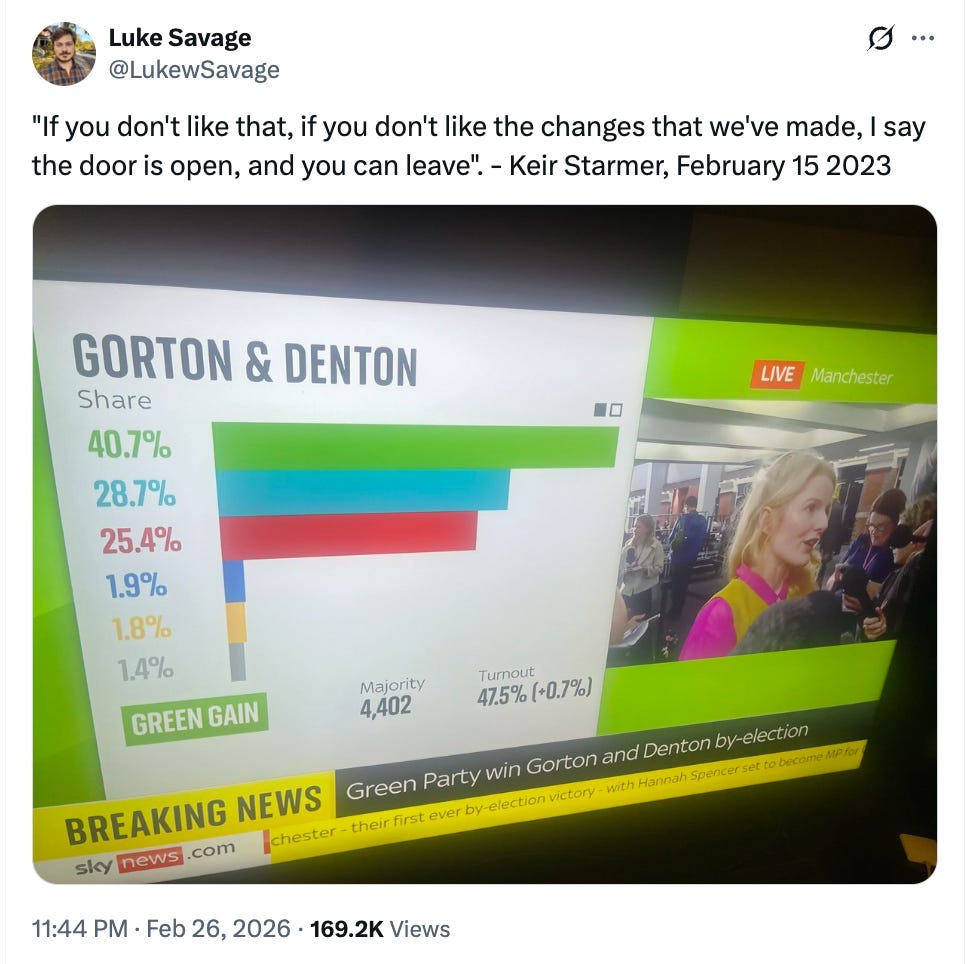
Labour’s dismal fortunes, confirmed by its recent third place showing in the longtime fortress seat of Gorton and Denton, only underscores the continued salience of 2017 and the broader electoral dynamics it revealed.
For decades, leading politicians and strategists of the neoliberal centre have confidently told everyone that you can not only win without the left but that parties like Labour or the Democrats can actively gain ground by openly scorning and alienating it. In the US context, Kamala Harris’s failed strategy against Trump offers us further evidence to the contrary.
The lessons of 2017 remain a living rebuttal to the neoliberal theory of electoral politics. But they remain relevant for the left too, because they give us a glimpse of what a successful electoral coalition will probably look like if it coheres in Britain or anywhere else: the socialist left in partnership with progressive liberals; a vanguard of downwardly mobile young voters; cross-class, multiracial; urban and post-industrial. Centrist neoliberals, with their derelict analyses and horseshoe theory of politics, cannot possibly build a coalition so broad — and, if the far right continues its ascendency, it will be the only viable alternative.
If Labour is to survive in any form it needs a new leader NOW. Nobody in the current cabinet, or any Zionist funded MP should apply for the job.
I, too, remember the euphoria of 2017. I was a labour party member most of my adult life but not now. I left the party under Blair and rejoined under Corbyn. Had the wicked factionism, as detailed in the Forde report, not occurred Corbyn would have won that election. The country was ready for socialism, except the media of course.
Now the Green Party is our only hope.
what do you think of the relatively more anti-market policies of the starmer government, like higher minimum wages, rent tribunals, cancelling welfare reform on behest of the party’s soft left, etc? I don’t see much commentary about these from the left but they definitely annoy the more centrist/right voters