


Note: Until the end of the July, I’m offering paid annual subscriptions at 50% off the regular rate. You can redeem that offer here, and I hope you’ll consider supporting my work if you can.
The most deeply held belief of every centrist pundit from Washington to London is that their worldview, if actually given the chance, would be both politically successful and wildly popular. Substantively, the exact contours of that worldview might vary — the centre, after all, is defined by what it sits between and centrists are the last people anyone would accuse of practising ideological consistency — but since the Clinton/Blair projects of the mid-1990s, it has generally had the same ur-form.
In policy terms, neoliberal centrists want a government that hungrily embraces markets and abandons the old social democratic delusion they can be meaningfully regulated or contained. When there’s a backdrop of economic growth and they’re feeling generous, they might tolerate a few drops of social liberalism too. But even then, they usually want a dollup of social revanchism to run parallel: directed, perhaps, against migrants, welfare recipients, or anyone else without political power they think might be a useful foil. This, they insist against all evidence, is actually a common sense formula for broadly-shared prosperity and the best all you fucking little piggies are ever going to get.
And even better? Absolutely everyone is going to love it. In every suburb and exurb; on every street where people care about their neighbours, have legitimate concerns about rising crime rates, and the sweet scent of means-tested tax credits drifts wistfully upon the air; in every erstwhile manufacturing town hollowed out by deindustrialization where former machinists and coal miners (one imagines) talk of diligence, personal responsibility, and the urgent need for deficit-reduction around the water cooler, the centrist political offer is going to win big if given the chance.
This, in fact, gets at the real heart of centrism. There is simply no there there, because the whole thing has always been about a kind of political and economic “realism” that could only ever sound novel or attractive in the 1990s. If you’re going to slash the welfare state, you need a giant financial bubble or the windfall from freshly-privatized public assets to keep the lights on. But you also need a very specific kind of cultural moment to give a fundamentally bankrupt project at least the momentary appearance of dynamism. Without one, what remains is just a howling echo chamber of elite received wisdom laundered through think tanks, focus groups, and the smarmy bafflegab of overpaid spin doctors; a listless quest for popularity among an imagined electorate of idealized median voters that is inherently self-defeating.
Something like this has been the basic playbook of parties like the Democrats and British Labour (save the Corbyn interlude) for more than two decades, yet the people most committed to it incessantly tell us it has never really been tried. That rather unconvincing claim only gets louder when centrists lose elections, which is why we keep hearing — from the very pundits who lauded Kamala Harris’s campaign as a brilliant and savvy expression of their own philosophy — that their perfect candidate was in fact captured by the left. But I have good news for the Jonathan Chaits and Matthew Yglesias’ of this world because there’s a quaint little kingdom across the ocean in which their favoured political model has been put to the test under lab conditions. The bad news is that it sucks and everyone hates it.
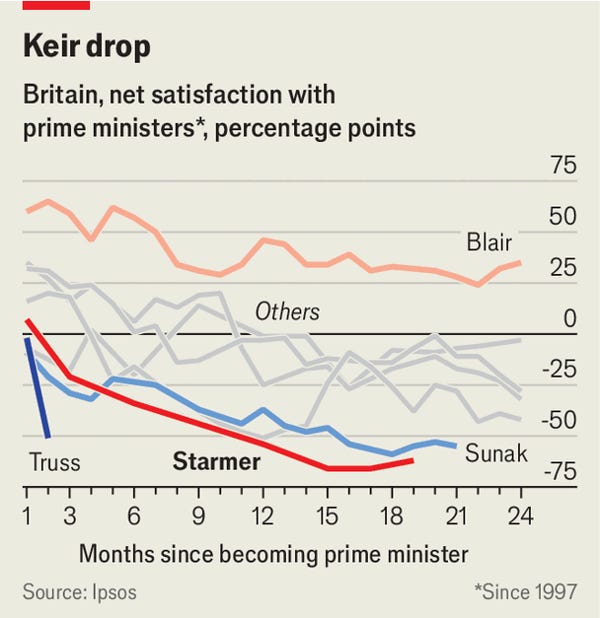
Keir Starmer entered Downing Street with an Atlee-esque majority secured on just 33.7% of the popular vote. Unlike Clinton or Blair, he was never well-liked by real people to begin with and his actual project — beyond executing a neo-Stalinist purge of socialists from Britain’s nominal socialist party — was never very clear to the public. This, I suppose, was more or less the point. The so-called “10 pledges” with which Starmer originally won the Labour leadership were pledged precisely so they could be repudiated — after which a massive surge in popularity would supposedly ensue. It didn’t, of course. But the Tory party self-immolated and Labour’s parliamentary landslide gave the indomitable Sir Keith a carte blanche on which to implement his agenda without constraint.
As a person who lives in a Westminster parliamentary system, I really cannot underscore this point enough. When you press American Democrats on the failures of their campaigns, the hollowness of their administrations, or their contemptible concessions to the right, they invariably tell you there was no alternative and that they had no choice. America is a centre right country! They gerrymandered the districts! We needed 60 votes in the Senate! We have to think about the damn midterms! etc etc. An equivalent British administration, however, has no similar rock under which to hide. With 411 of the House of Commons’ 650 seats, a prime minister can effectively pass any legislation they want. Through the exercise of party discipline, hardly needed anyway in Starmer’s case thanks to his regime’s authoritarian control of candidate selection, the executive branch can make or eliminate laws and regulations as it sees fit.
And what intoxicating vistas lay in wait. In due course, Starmer did away with the hated, unpopular policies of centre-left governments past and proceeded to do the kinds of righteous and exceedingly popular things that the median voter craves instead. It cheerfully welcomed the patronage of the world’s billionaires and plutocrats. It handed over portions of the state to Big Tech and high finance. It embraced J.K. Rowling’s gender policies. To save a few bucks and make ritual sacrifice to the financial markets, it cut winter fuel allowance payments because apparently not enough pensioners were freezing to death in the winter. It armed Israel to the teeth, criminalized dissent, openly channeled Enoch Powell, and aggressively purged the left.
The result, even before recent revelations involving Jeffrey Epstein and Blairite sicko Peter Mandelson, was a premiership more hated and detested than even that of Liz Truss; one a train wreck in every sense — moral, ethical, or political — whatever credulous pundits and lobby journalists may say to the contrary; a government whose contemptible triangulations have brought Nigel Farage and Reform to the very cusp of power. There is little reason to think a US administration led by Kamala Harris and cheered along by the likes of Jonathan Chait and Matt Yglesias would have been qualitatively different.
Neoliberal centrism has, in fact, been tried — and no one should let it anywhere near power ever again.
The “real Starmerism has never been tried!” thing is a pretty clever way to frame this issue. That *is* basically what liberals have been saying for decades, but lands much worse than the ubiquitous “Socialism has failed everywhere it’s been tried.” argument.
You said something like this years ago and it’s stuck with me “The problem with neoliberalism is that you can only privatize a public good once.” And I think that kinda sums up the zombified state liberals are in. Labour can continue to underfund schools and hospitals, but until an industry is nationalized for them to privatize they don’t have a concrete project and if what they did could be argued as trickling down to the public on their best terms, then it dried up with the dissolution of the spice girls.
A close Carney neoliberal collaborator along with Macron and Von der Lyin. Oh and a security aarangement with the genocide enabler Merz from Germany.