

There’s a viral clip of Holly Valance that’s been making the rounds on social media in which the Australian actress, asked about her political trajectory, says this: “I would say that everyone starts off as a lefty and wakes up at some point after you start either making money, working, trying to run a business, trying to buy a home and realize what crap ideas they all are.” Valance, who has been a quite vocal supporter of politicians like Nigel Farage and Donald Trump, may be a somewhat distinct case here. But I also think the sentiment she’s expressing is one plenty of people — including non-conservatives — have internalized even though it isn’t really true.
As an addendum to the piece below, which is now a few years old, it’s worth acknowledging that right of centre parties like the Conservative Party of Canada have actually been faring somewhat better among young voters in elections since. Though I wrote what follows partly to explain the drift of many millennials and zoomers to the political left during the 2010s, I think recent developments only serve to underscore the underlying point that the way many people like to generalize about how political values necessarily correlate with either youth or age leaves much to be desired.
A version of the following was first published in Jacobin in 2020.
Some years back, I attended a panel discussion at the Manning Centre Conference — in its day the biggest annual gathering of Canada’s conservative movement. A number of well-known Conservative MPs gave speeches, and in the Q&A that followed, the moderator asked each to offer some insight into how they thought conservatives might make their project more appealing to the young. Most or all issued some version of the same reply: “Young people love freedom, and so do we!.”
As the solitary socialist in the room, I found myself privately scoffing. Whatever this reductive declaration was supposed to mean, it was obvious — then as now — that the word “freedom” meant something very different to the people on stage than it did to me. In the 2015 federal election, for example, despite an unprecedented increase in youth turnout, the Conservative Party had finished firmly behind both the centrist Liberals and the social democratic NDP among those aged 18–24.
NOTE: I keep as much of this Substack free as I can, but as a freelancer I depend on the income I receive from writing so please consider subscribing at one of the paid tiers if you can afford to contribute. Those who do so will get instant access to every paywalled piece in full, including those from the archives.
In context, however, the sentiment did have a certain coherence. It later occurred to me that these Tory MPs positing a frictionless union between their own conception of freedom and the values of today’s young were all either Gen-Xers or youngish members of the baby boomer generation — which is to say: people who grew up against a backdrop of postwar growth and came of age politically during a period of broadly shared prosperity (at least when measured against the present day). Keynesianism was the economic order of the day and the welfare state, though still relatively new, was an integral part of the political consensus.
Within such a climate, it’s not terribly difficult to see how the ascendant project we now today call neoliberalism might have had intuitive appeal to some people under the age of 30. New and insurgent, it quite ingeniously channeled the individualist zeitgeist of the 1960s while recasting it in market-centric terms. It promised liberation from the supposed fetters of an activist state it also successfully blamed for various crises and social malaises. Perhaps more to the point, the thrust of its intervention came after many Gen-Xers had already enjoyed the fruits of postwar social democracy in their early years: consistent growth, high union density, rising wages, free or nearly free college and university, etc. It was in this context that conservatives of a particular generation forged their politics and worldview.
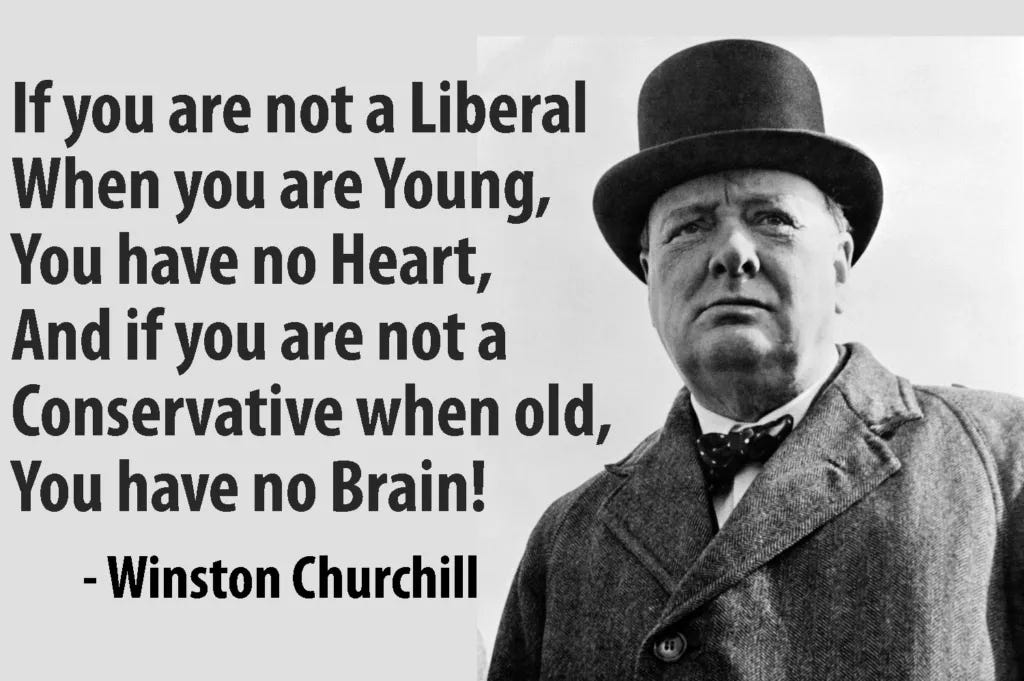
Not everyone felt the same way, of course. Generations are, by definition, a somewhat hazy and arbitrary construct and plenty of people, young and old, fiercely resisted the right-wing counterrevolution of the 1980s and ‘90s. But, considering how many eagerly jumped on board, this history is a useful corrective to the popular idea that youth engenders radicalism and age sees it melt away. This is, I think, a widely believed truism about the typical person’s political trajectory and is perhaps best expressed in that famous quote erroneously attributed to Winston Churchill: “If you’re not a liberal when you’re twenty-five, you have no heart. If you’re not a conservative by the time you’re thirty-five, you have no brain.”
The thing is, a perfunctory glance at the political behaviour of young people belonging to different generations suggests this just isn’t true. In both Britain and the United States — neoliberalism’s two most significant political epicentres during the 1980s — young people actually voted in large numbers for the conservative politicians who carried out the dismantling of the welfare state. Ronald Reagan essentially tied Jimmy Carter among voters 18–29, winning easily every other age group including people 30–44. By 1984, this dead heat became a rout. Here, for example, is how the New York Times reported on Reagan’s youth prospects mere weeks before an election he would win in a landslide:
“In the late 1960’s, the rallying cry for many young Americans was, ”Don’t trust anyone over 30.” In 1984, by contrast, the youth culture appears to put its trust in a President who is over 70. According to combined figures from the two most recent New York Times/ CBS News Polls, taken before the Presidential debate on Oct. 7, voters from the ages of 18 to 24 supported Mr. Reagan by 61 percent to 30 percent over his Democratic challenger, Walter F. Mondale.”
Margaret Thatcher actually won the youth vote in her first two elections, drawing about even with Labour among voters 18–24 in 1979 and winning every demographic over 35 by 10 percent. By 1983, the Tories got more support from those 35–44 than those 65 and older and secured some 41 percent support from those voting for the first time.
If this picture grates against our intuitive sense of the correlation between political values and age, it’s probably because young people today are often more likely to lean left than they were four decades ago, the generational gulf separating millennials and zoomers from boomers and Gen-Xers being pretty difficult to ignore.
During the 2020 Democratic primary race, as in 2016, Bernie Sanders won the youth vote in unprecedented numbers, with older voters breaking overwhelmingly for Joe Biden. In the United Kingdom’s general election upset of 2017, Labour won every age group under 39, capturing more than 60 percent of the vote from people aged 18–29. A Gallup poll conducted in 2018, meanwhile, found that only half of young American adults now have a favourable view of capitalism — down 16 percent since 2010 — while about the same proportion now has a favourable view of socialism. Though a less than negligible plurality of older people also view socialism positively, it’s undeniable that a considerable majority favours capitalism.
Rather than assume these trends reflect attitudes that inherently come with either youth or age — which, as we’ve already seen, doesn’t really stand up to scrutiny — we might ask why it is that young people today are often so much less inclined towards capitalism than their parents or grandparents. The simple, though oft-ignored answer is that the average young person in the 21st century has had a radically different set of experiences and developed a quite different set of political values to match them. In 1960 the median American house price was around $97,000 adjusted for inflation; today the figure is $226,000. Whereas wages grew steadily for workers in the decades between the 1940s and the 1970s, most haven’t seen the value of their paycheques improve since. In many societies, social mobility has plummeted while education has grown increasingly expensive and good jobs harder to come by.
Common Experience
If you’re under 40 today, there’s a good chance capitalism hasn’t served you particularly well and that exhausted political narratives emphasizing individual grit and personal responsibility carry a very different connotation than they once did to an earlier generation. The postwar/Keynesian version of capitalism, and the economic prospects it once guaranteed, are completely unimaginable to most of us today. Some of the hardest working people I know barely hover above the poverty line and even the more professionally successful among my friends and acquaintances are unlikely to have much in the way of savings (though they probably have plenty of debt).
This is anecdotal, of course, which is a good moment to issue the standard caveats about conceiving of politics in generational terms. First of all, generations aren’t monolithic things: their boundaries being somewhat arbitrary and people within them having a limitless multitude of social backgrounds and experiences. Not every millennial or zoomer is hostile to capitalism and there are plenty of people over 60 who either radicalized with age or never abandoned the left-wing politics of their youth. Generations also have plenty of material and cultural divisions within themselves, making the imposition of some unitary narrative a messy and sometimes pointless exercise. They’re also, to some extent, an invention of capitalism itself. As journalist and music critic Jeff Chang has argued: “Generations are fictions, often created to suit the needs of demographers and marketers.”
Still, there’s no denying that generalized trends predominate among particular age groups and that some degree of shared experience is the most obvious explanation. This experience is the key because political ideology is ultimately the intellectual and moral shorthand through which people explain and interpret their reality. There is nothing inherently radical or reactionary about belonging to any particular generation just as there’s nothing inherently progressive or conservative about being a particular age. There is no singular epistemology that comes with youth and wanes with maturity, but there are a broad set of experiences and social facts that inevitably shape people’s attitudes and political views.
Millions born at the end of the twentieth century or the early part of the twenty first did not enter life with some special disposition that made them receptive to socialist or left wing politics. Rather, looking to political alternatives like socialism or opting out of political engagement altogether (something large numbers of young people also do) are rational responses to the world as they have experienced it: one defined by the manifold crises, financial meltdowns, and political upheavals liberal democracies have experienced since the end of the 1990s.
This does not mean, of course, that the left should start dealing in crass generational politics or rest on its laurels while awaiting rescue from some imagined future cohort that will inevitably sweep it into power. (In an odd way, understanding the sources of generational belief actually stands as a warning against the very idea of seeing politics in generational terms, insofar as this tends to presume some intrinsic correlation between age and conservatism, or vice versa.)
Instead, social and material realities — not the discrete internal cultures thought to belong to people of different demographics — should be our guide: the better to understand how capitalism is failing, and why so many young people are now looking to political horizons quite different from those of their parents and grandparents.
Gen Xer here. My trajectory started conservative and has been moving left ever since. Like anyone just turned 20 I was very much focused on my own navel and what I thought about it. I was seduced by the heroic mode of politics, the single actor who made a difference. I was reading Mishima, disgusted by the rot in the system. I wanted success and looked to those who had conquered the mundane for inspiration.
The more I learned about the world and about how it works, the more I moved away from this worldview. Talking and listening to a wide variety of people will push anyone leftward. Allowing yourself to be educated and changed by the world will make you a part of the systems that make it work. I get the feeling that those who move right as they age have given up participating in the world as it is and still choose the path of domination and control.
There’s something a little surreal about visiting the home of a radical boomer, because it’s very much a grandparent’s house, but the pictures on the fridges are being held there by magnets with Lenin quotes. Lenin who to my knowledge… was old.
This isn’t exactly the topic, but it’s related, I find it interesting that while there isn’t a hard generational divide as your article says, it does seem to be true that young people are overwhelmingly more likely to want to get involved in organizing than older people.