
The Wasteland
Influencer culture shows us a bleak future where all life has become commerce and markets have conquered the private self

Until the other day, I had never heard of Ashton Hall. But he’s an influencer with millions of subscribers across various platforms, and the star of a recent viral video that boasts an astonishing 720 million impressions on Twitter.
In light of strong interest, I’ve decided to extend last month’s discounted subscription offer. Until the end of April, that means you take out a full year’s subscription for just 50% the regular cost. To subscribe at the discounted rate and support my work you can click here or alternatively subscribe for free and still get the regular free posts sent right to your inbox.
Perusing Hall’s Instagram page (which has 10.7 million followers alone) it looks pretty par for the course for the genre. Hall maintains a lean and jacked physique. He wears chic blazers, drives sports cars, and wears expensive watches. He offers bland, generic lifestyle tips and preaches the kind of postmodern prosperity gospel that has conquered much of the online world since the 2010s. The videos themselves tend to be sterile and airbrushed, everything in them perfectly smooth and largely indistinguishable from more or less any male influencer doing the same schtick. Hall happens to be American, but apart from his accent he could just as easily hail from any number of places because the genre’s prevailing aesthetic makes the entire world look like a giant shopping mall in Dubai.
I got interested in Hall’s videos thanks to a recent exchange between Aaron Bastani and Ash Sarkar over at Novara Media. If you’re interested, you can watch their whole discussion, but for our purposes the relevant part is the two videos they include near the beginning:
These videos show us influencer culture at its most hollow and the grindset ethos at its most ridiculous. The image Hall projects is meant to be cool and aspirational. But he seems to spend the lion’s share of his day working out, eating by himself, and doing Patrick Bateman’s skincare routine.
As things are depicted anyway, he also seems to spend it mostly alone. Hall is alone at home. He’s alone in the gym. He’s alone at the swimming pool. And, insofar as other people do appear, it’s solely as props or appendages. As Bastani points out, the only times we actually see anyone else on camera (or even sense their presence outside the frame) is when they’re bringing Hall something or serving him food:
“[in both of these videos] he isn’t actually around anyone. He has no relationships to anyone. He’s just this little atomized unit: sharing content, making money, consuming. No partner in bed. No kids screaming. No parents to look after. No housemates. No nothing. Just this guy looking at screens all day, as well as his own reflection. The only time you see other people is when they’re doing something for him. And here’s where things get serious. Because if this is the vision of success we’re selling young people — as funny as it may be — where other people are clients or people serving you; [and] when you talk to anyone it’s via a screen; everything you do, from working out to eating, is done alone…Think about that for a moment and then ask: is it any wonder we’re seeing surging problems with mental health? If this is aspiration, what on earth is failure?”
Indeed, Hall might be an extreme case but something like this vision of aspiration now runs through much of popular lifestyle content.1 In an obvious sense, it reflects an ethos of success and personal fulfillment with clear roots in the worst excesses of gym culture (Patrick Wyman put this particularly well back in 2020). On a fundamental level, it’s also one deeply enmeshed in the calculi of markets — in many ways epiphenomenal of the metrics and algorithms that drive social media themselves.2 Hall himself, in fact, devotes plenty of videos to talking specifically about how he’s learned to juice the reach of his content and convert his viral numbers into monetary success.3
It’s quite bleak to think about. In obvious and disturbing ways, the incentive structures of digital media appear to be cultivating a vast cohort of young people — particularly though not exclusively young men — who are profoundly antisocial, and lack any real narrative of life beyond one of atomized hustle and endless accumulation. As Sarkar observes in the discussion above, the idea of “making gains” (borrowed from the world of bodybuilding) has, in effect, supplanted any notion of socially productive labour.
In this view, all life — in both the individual and the social sense — is essentially commerce, or at any rate has the potential to be. Each of us is just a walking, talking firm with a brand attached and an assortment of assets to be monetized or commodified as needed with the aid of market metrics.
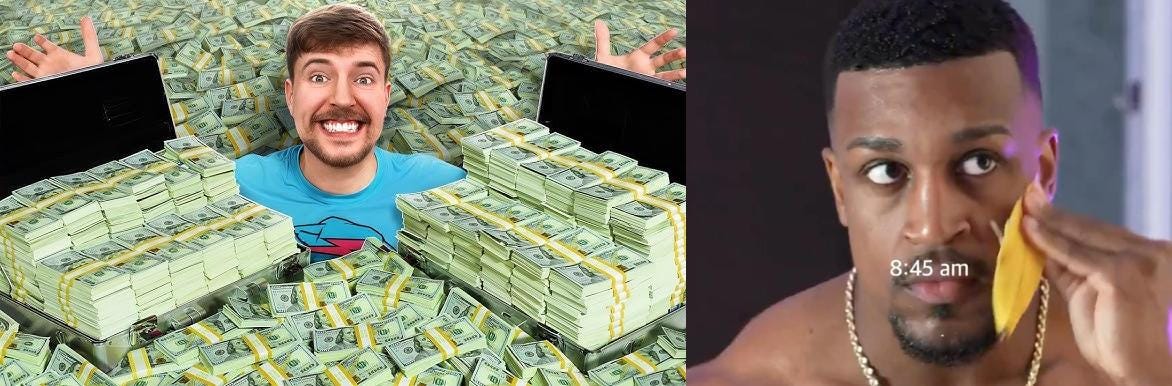
Aesthetically-speaking, this is one reason the dominant visual mode on platforms like YouTube now tends towards exaggeration and bigness for bigness’ sake. Mr. Beast, the most successful creator in YouTube history (at least in terms of raw numbers) has built a vast empire with videos that all look like this:

This homogenized aesthetic reflects the same, distinctly postmodern kind of ugliness found in AI-generated ads and Trump-branded NFT collections. More importantly, it shows us what the ethos of atomized, market-driven hustle looks like when expressed as an iconography and visual style. Mr. Beast, whose real name is James Donaldson, openly says he sees having a personality as a limitation to growth and, if life is conceived purely in the narrow market terms I’ve been describing, he probably has a point.4
Since its inception, capitalism has sought to project the cold logic of exchange value onto anything and everything it can. In the 20th century, this meant (among other things) the gradual transformation of public and common spaces into new sites of profit through billboards, advertisements, and so on. Today, we see the same process extending itself more profoundly into both daily life and the digital ether, culminating finally in the merger of the market ethos with the intimate, private self.5
The implications here go well beyond what’s become the accepted liturgy of much influencer discourse: that the lifestyles popular influencers promote are actually unattainable; that it’s bad for one’s mental health to be performing on camera all the time; that, beneath all of the favs and likes, the people themselves are secretly lonely and miserable, etc etc.
All these things might well be true, and in many cases they probably are. But in the most absurd excesses of influencer culture I actually see the harbinger of something far more unsettling and dystopian: a socially atomized world where everything — both physical and non-physical — has been turned into a commodity, even our dreams and aspirations come with view counts, all life is commerce, and there is literally no escape from the market.
On the very worst parts of the internet, it has found a natural partner in the reactionary hokum that makes up the so-called “manosphere” — where credentialed misogynists make a killing telling maladjusted young men that women are commodities, all relationships are transactional, that it’s actually gay to have feelings, and so on.
Incidentally, one of the only times Hall actually speaks in either video, it’s to to say “So looking at it bro, we go ahead and get in at least 10,000” to an unseen interlocutor on the screen in front of him. 10,000 of what exactly? It’s unclear, but all that matters is that it’s a really big number.
A few have speculated that we aren’t actually supposed to take these videos seriously — even by the usual standards of bro fitness content, they are indeed pretty absurd. Based on my own survey of Hall’s content, I really don’t believe that’s true.
One possible objection to my framing here is that plenty of influencers ply their trade by targeting a specific niche and/or by monetizing a specific personality. To this I’d reply: not one of them is getting a fraction of Mr Beast’s traffic or making anything like the same kind of money. He might be a singular and exceptional case, but that’s precisely because he’s taken the logic of market-driven algorithms to its natural conclusion.
In its early days the internet was widely considered, and widely experienced, as a much freer and less gentrified space. Today, almost everything now comes to us by way of algorithms that are themselves controlled by a handful of global monopolies. Almost every website is peppered with ads and non rent-seeking space of any kind is ever harder to find. From NFTs and cryptocurrencies to the so-called Metaverse, most of the efforts comprising what is generally called “Web 3.0” are fundamentally (and revealingly) about the extension of markets into the digital ether and the further commodification of virtual space.