


Note: I keep as much of this Substack free as I can, but writing takes time and energy and if you’re able to subscribe here at one of the paid tiers and support my work you’d be doing me a solid. If you’re unable to afford a paid subscription, consider subscribing for free or send me a message and I’ll gladly comp your subscription.
This week, Britain’s new prime minister Andy Burnham delivered his first major speech to the Labour Party’s annual conference. I don’t want to comment on the speech as a whole, and will leave that others who’ve followed recent goings on in British politics more closely (Novara Media has an excellent roundup, and I also recommend pieces by Grace Blakeley and Owen Jones). But Burnham’s comments about electoral reform struck me in particular, because they immediately elicited memories of how these sorts of commitments have played out in Canada.
Instead of directly promising to replace Britain’s current first past the post system — a system Canada similarly uses — Burnham is promising to convene a national commission to explore various options, the ultimate goal of which will be to create a system where “everyone's vote counts, and everyone's voice is heard.” Burnham, for what it’s worth, has been supportive of proportional representation as recently as last year’s Labour conference. It’s also significant that he’s saying this as prime minister, because committing to electoral reform from opposition — and then conveniently forgetting about it when you win — is a whole lot easier to do.
Here, incidentally, is why the Canadian experience with electoral reform came to mind. During the federal election campaign of 2015 (which is to say, before he became prime minister) Justin Trudeau made the following pledge:
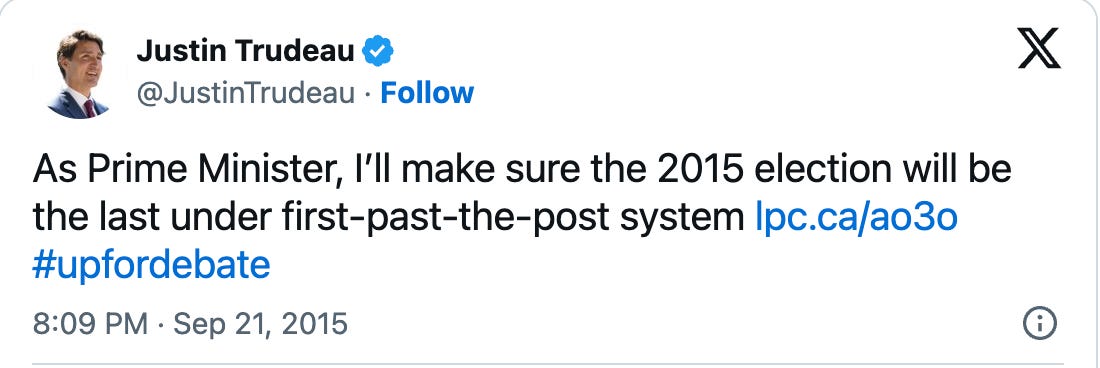
This line was endlessly repeated on the campaign trail and, in the crass electoral sense, it worked because it implicitly gave prospective NDP and Green voters permission to vote Liberal. Trudeau notably never promised to implement any specific system and was doggedly vague about what he actually intended to do. Instead, the 2015 Liberal platform promised a process — and notably made reference to ranked ballots, which are not actually a form of PR.
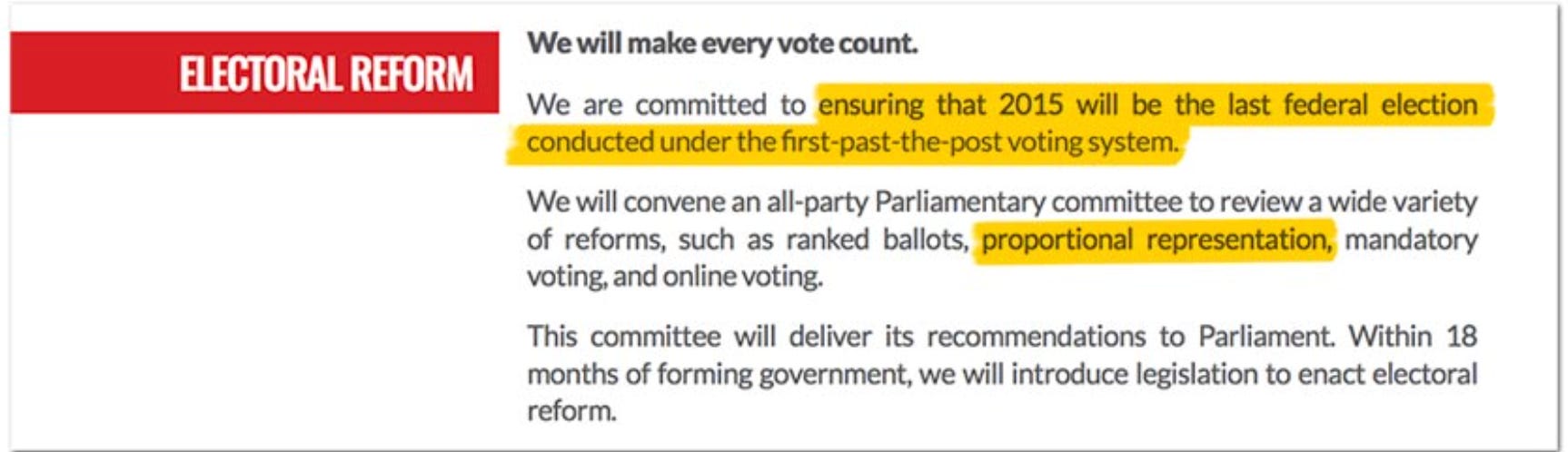
Following the election, an all-party committee was indeed convened and expert testimony strongly favoured proportional representation. After that, participants at town halls across the country overwhelmingly backed it as well. The result? Trudeau’s government broke its promise, abandoned electoral reform of any kind, and went further by attacking PR as something that would benefit the far right.
This, in fact, is merely one among several of Canada’s near misses with PR. Various provinces have put the question to a referendum (Ontario once and British Columbia twice), usually with a threshold that is incredibly difficult to meet. Again and again, these processes have brought together experts and ordinary citizens who passionately believe in electoral reform and have made earnest contributions. They’ve debated the merits of various systems — Single Transferable Vote, Mixed Member Proportional, etc — and pursued laudable campaigns of public education to build support for them.
And yet, I don’t think we’re any closer to proportional representation in Canada than we were 10, 15, or 25 years ago — despite the case for it probably being stronger than ever. All this has finally convinced me that electoral reform will only ever happen under the following two scenarios: 1) There is a minority Parliament and the largest party is compelled to implement it because it needs the support of a smaller party that is demanding it; 2) A party campaigns on an explicit pledge to implement a specific model of electoral reform, then promptly does so after it wins an election. No commissions, no parliamentary committees, no expert panels or town halls, no referendum. Just simple legislation, ideally followed by a well-financed public education campaign to explain the new system.
In Britain today, as in Canada, the case for some form of PR is pretty overwhelming. Multi-party systems regularly produce distorted outcomes under first past the post, and often give huge parliamentary majorities to parties that receive well under 50% of the popular vote (Britain’s current Labour government, in fact, won a landslide in 2025 on less than 34%). It’s possible that Burnham is sincere in his desire for electoral reform. It’s also possible that the unprecedented fragmentation of the UK’s electoral map will create the right combination of incentives for various parties, including Labour, to back PR.
I certainly hope so. But Canada’s experience with electoral reform is a bracing testament to where these sorts of pledges usually go.
Why not a political commitment to implement pr by fixed date but have a citizen’s assembly supported by experts to recommend design?