

NOTE: Until the end of the year I’m offering 50% off annual subscriptions. Click here to subscribe at the discounted rate.
It being nearly the end of the year, I’ve been thinking about how best to close out 2025 here on Substack. As it happens, I’m planning to partly shutter things here for a few weeks and take some proper time off from the 19th until early January. I’m very lucky to be able to write full time for a living, but between writing, podcasting, and the much bigger project I’ve been chipping away at (of which more soon…), it can be absolutely exhausting sometimes. Which is all to say: it will be nice not to post things for awhile, though I may load up a few pieces and schedule them to publish during the holiday doldrums.
Anyway, the end of the year seems to have become the designated time for roundups and lists, so here’s the first of mine. I’m not going to say too much about each of these, since they could all sustain a dedicated piece of their own. They’re in no particular order, are variously fiction and non-fiction, and vary in terms of both style and theme. Nonetheless, all of these have really stuck with me — and the same will go for those coming in Part 2.
All That Is Solid Melts Into Air, by Marshall Berman

The late Marshall Berman (1940-2013) was a professor at CUNY and a contributor to magazines like Dissent and The Village Voice. I discovered this book of his, originally published in 1982, quite by chance while perusing a shelf in my local bookstore and it sucked me in from the very first sentence. It’s so good I’m somewhat embarrassed to have only discovered it now, but I’m very glad I did. Berman was a critic of postmodernism and his goal in this book is to make the case for both modernism as an artistic movement and modernity as, in his words, “a mode of vital experience” shared by people throughout the world today. That mode of experience, he argues, is by no means straightforward or frictionless. To be modern, in fact, is…
to experience personal and social life as a maelstrom, to find one’s world and oneself in perpetual disintegration and renewal, trouble and anguish, ambiguity and contradiction: to be part of a universe in which all that is solid melts into air. To be a modernist is to make oneself somehow at home in the maelstrom, to make its rhythms one’s own, to move within its currents in search of the forms of reality, of beauty, of freedom, of justice, that its fervid and perilous flow allows.
To make his case, Berman leads us through a swathe of quintessentially modernist texts — some philosophical, some literary. The result is nothing less than a banquet of interesting ideas, courtesy not only of Berman himself but also the likes of Goethe, Marx, Dostoevsky, and Baudelaire. It’s a rare and special experience to discover something that so perfectly articulates things you’ve been thinking for years but have never found a language to express. I regret that I’ll never meet Berman, but I expect I’ll be returning to this book for years.
A Place of Greater Safety, by Hilary Mantel
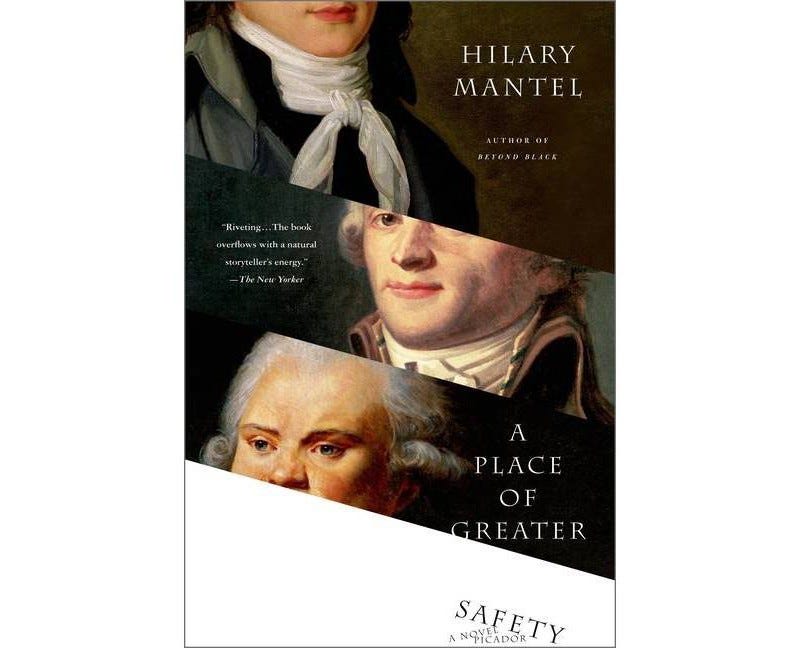
I actually read most of this one at the end of 2023 and the beginning of 2024, but I returned to finish the last 50 pages or so in January. At nearly 750 pages, A Place of Greater Safety is a long and challenging novel — and more so than others of similar length. That’s primarily because Hilary Mantel (1952-2022) aspires to be magisterial in her treatment of history; in this case, the history of the French Revolution as seen through the eyes of Georges Danton, Maximilien Robespierre, Camille Desmoulins, and those who knew them. An author’s note included at the beginning gives a good sense of just how fastidious she was with her research, and how seriously she took the enterprise of bringing history to life. In fact, Mantel wrote the first draft in the 1970s and couldn’t find a publisher until 1992 because, it seems, no publisher could quite get their head around what the book was doing.
