

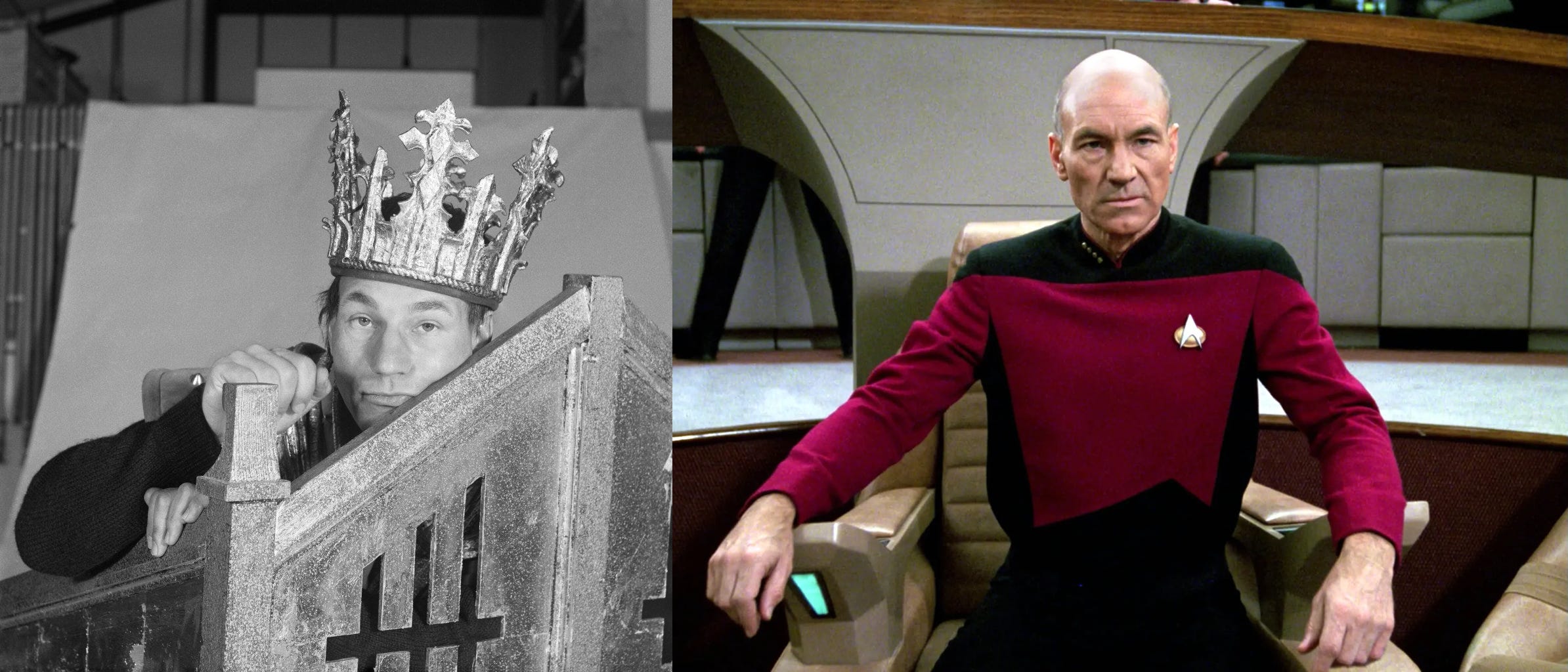
One of my earliest memories is watching Patrick Stewart on Star Trek: The Next Generation with my parents, circa age 3. This was during its original run and, being nearly fifty already, Stewart already had decades of film, theatre, and television behind him. He was quite simply great in everything and had an ineffable ability to lend gravitas to any role, big or small. In some ways, he probably deserves to be remembered for his portrayals as Lear or Prospero. But I suspect that to many of us he’ll always first be Jean-Luc Picard.
I have nothing particularly original to add to the deluge of tributes that have been pouring in since news of Stewart’s death broke yesterday. He seems to be have been about as close to a universally beloved figure as it’s possible for anyone to be and was by all accounts a lovely person. He was a man who loved poetry and art, a trade union supporter, and a self-identified socialist. He supported gay rights and publicly opposed the Iraq War. He could deliver a Shakespearean soliloquy with epochal force but was equally able to laugh at himself (see below). Great talents are not always good people, and plenty of them haven’t been. But Patrick Stewart always seemed like a genuinely good guy. In one way or another, and in too many roles to count, I’ve been watching him for as long as I can remember and, as irrational as this is, it’s hard to believe he’s actually gone.
Stewart’s portrayal of Picard must easily rank as one of the greatest performances in the history of television. Even in the periodic silly moments and wacky episodes that punctuated TNG’s early seasons he always, somehow, made it work. Later, after the show properly found its feet, he was an absolute tour-de-force in episodes like “The Inner Light” and “The Best of Both Worlds/Family”. In Stewart’s hands, Picard was a remarkably textured character: a man of deep passion who was also intensely private and reserved; one invested in institutional codes but never ethically entrapped by them; simultaneously French and Anglo in origin; an explorer and man of science who preferred ascetic living, loved old books, and was fascinated by archeology; a staunch military man who was in every sense a democrat; a natural leader who radiated authority but had been a libertine in his youth and was still secretly ashamed of it.
Anyway, there’s a somewhat throwaway episode of TNG that’s always been one of my favourites. “Starship Mine” (Season 6, Episode 18) has never been particularly well regarded and is understandably overshadowed in a season that also includes classics like “Tapestry” and “Chain of Command.” But, save a less interesting b-story that takes place outside the Enterprise, it’s largely Picard-centric and thus gives Stewart full latitude to do his thing.
The granular details of the plot don’t matter all that much. But, basically, the Enterprise has to be temporarily evacuated so it can undergo something called a “baryon sweep” that won’t damage the ship but is instantly lethal to anyone who remains aboard. Picard leaves too, but decides to go back to get his saddle just before the sweep begins after discovering there are horses on the nearby planet. Just as he’s about to leave the ship again, he spots a small group of people who are very clearly not supposed to be there. These turn out to be criminals who are planning to rob the ship, which sets off a deadly game of cat and mouse as Picard tries to thwart their scheme while the sweep passes deeper and deeper into the ship.
Stewart, as usual, plays the whole thing incredibly.
Using his superior knowledge of the ship, the Enterprise’s captain sets booby traps and takes down each criminal in turn — one with a poisoned crossbow bolt to the leg. After being captured by the gang’s ringleader, he plays dumb and pretends to be the ship’s barber (Picard, like the man who plays him, turns out to be a very good actor). She eventually escapes with her prize. But Picard, who has been as restrained in his violence as it’s possible to be, has quietly removed a safety rod from the stolen material, guaranteeing a massive explosion within a minute or two of its leaving the ship.
“Sir, an unidentified scout ship has just beamed someone off the Enterprise,” Data (Brent Spiner) tells him from the planet’s surface after shutting off the baryon sweep in the nick of time. “Do you know anything about it?” Picard’s somewhat laconic reply — “I know they won’t get very far” — is delivered just perfectly, conveying a mixture of relief, grim satisfaction, and profound regret that the situation has come to this.
As far as TNG episodes go, “Starship Mine” isn’t in the top 20 or even top 50. Its premise is decent but not particularly innovative relative to plenty of others and it’s hardly a brilliant character study in the mould of other Picard episodes like “Tapestry.” But it’s an incredible performance nonetheless and only an actor of Stewart’s calibre could possibly have done so much with so little. We’re really going to miss him.
I liked the TNG universe and I can't unsee the short video of Stewart stating his support for Israel long before Oct 7.
Let’s not forget Gene Roddenberry posed a challenge to society to allow their minds to boldly go into communist ideas (ie, Marx the humanist). TNG was spectacular and I will always treasure Stewart’s portrayal of Picard, in spite of the series of that name, and Trek (SciFi as a whole for that matter) being profaned by Jar Jar Abrams.
Picard embodies our liberated ideal, a promise of the future, exploring what it means to be human after the end of history. I would argue that while the general pop wouldnt even be aware of the metaphor (and frankly not relevant for developing a passion for Trek), the reason why Trek under Roddenberry and the people immediate following him resonates the way it does has everything to do with that percolating unconscious desire to be freed from our chains. Remove those safety rods folks.
Gurney Halleck in that bonkers product of Dune will be my fondest memory Stewart. Boldly go Sir Patrick.