


Note: I keep as much of this Substack free as I can, but writing takes time and energy and if you’re able to subscribe here at one of the paid tiers and support my work you’d be doing me a solid. If you’re unable to afford a paid subscription, consider subscribing for free or send me a message and I’ll gladly comp your subscription.
If you’re a non-Canadian reader, you may have seen headlines like this one (from the BBC) in the international press this morning: “Separatist party wins Quebec election, adding new test to Canada’s unity.” I’ve seen coverage elsewhere to this effect and, anecdotally at least, a few takes out of English-speaking Canada in a similar vein. I’ll confess to not having followed this particular Quebec election as closely as I’ve followed some others, but I do find this framing somewhat perplexing and wanted to share a few related thoughts.
1) The results
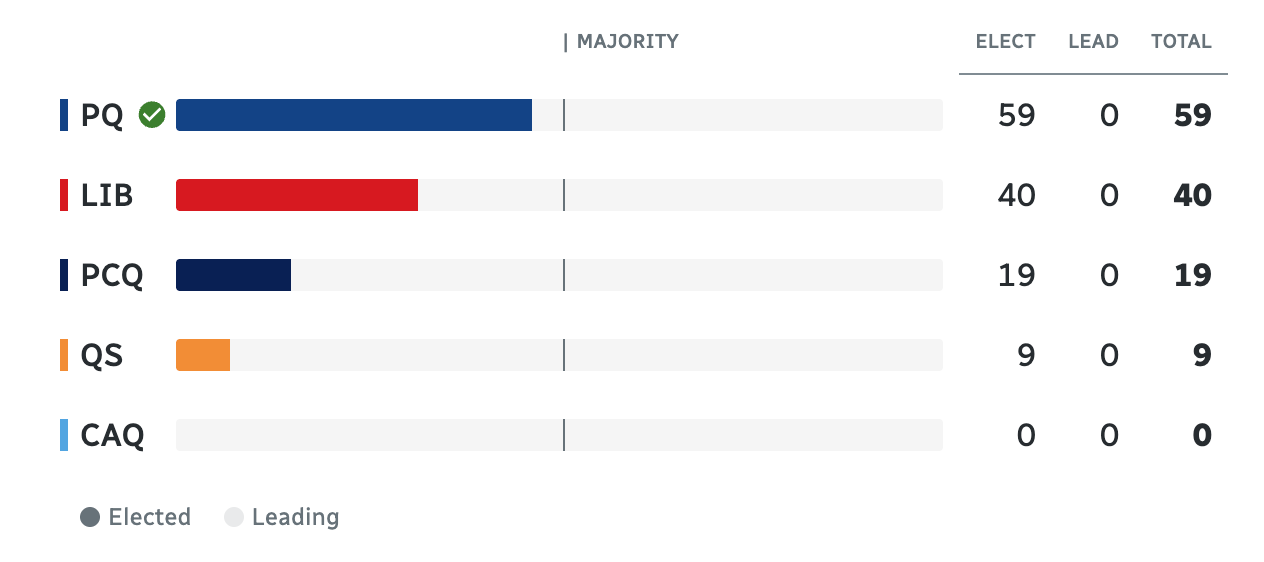
To first deal with the obvious, the sovereigntist Parti Québécois did indeed win the election — just. In fact, with a minority government and less than 30% of the popular vote the PQ ultimately underperformed compared to what many polls had suggested was possible.
The other big story here (obviously) is that the ruling Coalition Avenir Québec, which has governed since 2018 and which won 90 seats in the National Assembly just four years ago, was completely wiped out — with even Premier Christine Fréchette losing her seat in Trois-Rivières.
The CAQ did manage a little over 13% of the vote, but under Quebec’s electoral system this doesn’t count for much. It’s also, I think, reflective of the fact that the CAQ — right of centre, nationalist but not separatist, cobbled together from breakaway chunks of other parties, partly a personal vehicle for founding leader François Legault — has always been something of a cartel party and was never a very coherent formation in the first place. I fully expect the CAQ to disappear as a factor in Quebec politics.
The other novel part of the results here is the surprising success of the Conservative Party (not affiliated, incidentally, with the Conservative Party of Canada). This probably reflects the collapse of the CAQ to some extent, though I really have nothing interesting to say about it. Finally, Québec Solidaire — the only real left wing formation competing — lost two of its seats but had a slightly better night than some polls suggested was coming. Depending on how things play out, it may be in a position to exert some positive influence over the (increasingly right-leaning) PQ in a minority legislature.
2) The PQ’s victory
With the above out of the way, I think it’s worth reflecting a bit more on what so many of the newspaper headlines are focusing on this morning, i.e. the fact of a sovereigntist party committed to creating an independent state forming a government. If you’re a foreign reader and are basically going on these headlines alone, you might be under the impression that a PQ government is somehow novel to Quebec. But it isn’t. In fact, the PQ has been — alongside the federalist Liberals — one of the two dominant parties in the province since the mid-1970s. For that reason, I think it’s a bit misleading to interpret a result like this as having a 1:1 relationship to the cause of Quebec independence. Plenty of those who vote for the PQ, of course, passionately believe in this cause but Quebec is a political culture like any other and people’s political preferences are similarly shaped by their views on other issues like immigration and the cost of living. Leader Paul St-Pierre Plamondon, incidentally, campaigned partly by leaning into conservative culture war politics (among other things, a departure from the PQ’s more social democratic roots).
All that said, the PQ is officially committed to holding a third referendum on Quebec independence — the others having been in 1980 and 1995 — after Donald Trump leaves office in January 2029. What, then, should we make of that pledge?
3) The national unity question
Since so many write ups on the Quebec election seem to be focusing on the supposed threat to Canadian unity posed by the incoming PQ government, I think it’s worth saying outright here that the current background conditions are especially — perhaps even uniquely — inauspicious for the sovereigntist side. The PQ has won a minority government with less than 30% of the vote, Mark Carney remains popular in the province, and polls suggest there is presently record low support among Quebecers for independence.
Back in 1980, the PQ was still a new force in the province, the Quiet Revolution was still fresh in people’s minds, and Canadians politics as a whole was consumed by existential and constitutional questions. In 1995’s much closer vote, the Yes side benefited from the recent failures of the Meech Lake and Charlottetown Accords — which, again, reflected the continued salience and deeply contested nature of constitutional questions in Canada as a whole.
There is simply nothing analogous now and it seems to me that a hypothetical Yes campaign in 2029 will have a much shakier foundation on which to stand. If I can make a less dispassionate point here, I think the reduced salience of the sovereignty question in Quebec is also something of a testament to the success it’s had in safeguarding its culture and majority language. It was by no means inevitable that a few million Francophones living amid a vast sea of English speakers would be able to endure as a distinct society. But no one who visits Quebec today would ever doubt for a second that they are anywhere else and, in many ways, Quebecers have probably been more successful than their Anglophone counterparts in the rest of Canada at resisting the cultural gravity of the United States.
Anyway, things could always shift in the years ahead. Canada is an unpredictable country and the 21st century is a uniquely unpredictable time. But if nothing changes and the PQ does decide to hold another referendum, there is no reason to think it will meet with much success.
4) Federal implications
I’ve seen several headlines suggesting the PQ victory will be a test of national unity and thus a problem for Mark Carney. In fact, I wouldn’t be surprised if there is some mild disappointment among federal Liberal insiders that the PQ didn’t perform a bit better. In a crass strategic sense sovereigntist Quebec governments have sometimes been a boon to federal Liberal ones in the past because they’ve increased the salience of “national unity” in the rest of Canada and this has traditionally redounded to the Liberals’ benefit.
Anyhow, I think I’ll conclude these somewhat scattered impressions there. Who knows? With a minority legislature incoming at Quebec’s National Assembly, Quebeckers may not have to wait very long before they go to the polls again.
Thanks for this insightful read, Luke! I was wondering why Quebecers voted in a separatist party when overall support for Quebec sovereignty is at near-historic lows. This explains it with nuance.