


Note: Until April 1st, I’m offering annual subscriptions at 50% off the regular rate. There’s never been a better time to subscribe, and you can redeem the offer here.
EKOS pollster Frank Graves has just released a set of new numbers that offer us a fascinating snapshot of Canada’s current federal landscape.
His top line finding, echoed by other pollsters, is that — roughly a year after becoming prime minister — Mark Carney remains very popular, as does his government. If an election were held today, in fact, the Liberals would likely be on course to win well over 200 seats, and possibly a landslide that would rank alongside Brian Mulroney’s in 1984 and John Diefenbaker’s in 1958. Even more remarkable are some of Graves’ regional numbers, especially in Alberta where the Liberals are actually four points ahead of the Conservatives.
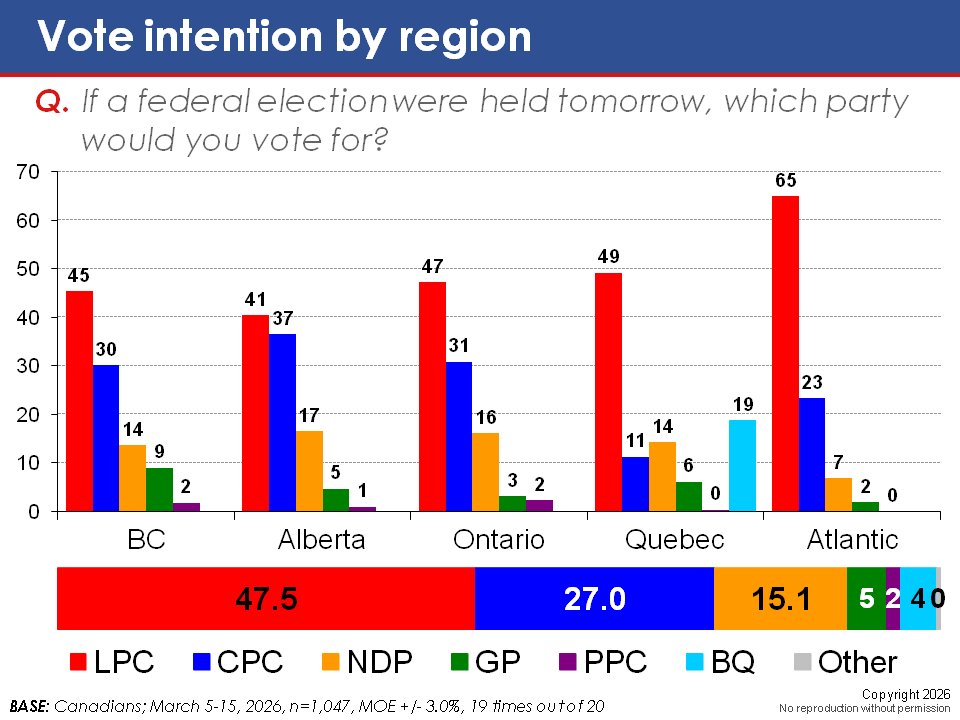
The other striking thing about these numbers is the relative recovery they suggest may be underway for the New Democratic Party. By historical standards, 15 percent would be a fairly average result for both the NDP and its predecessor the CCF. But it would also be more than double the vote share the party received in last year’s federal election (6.29%) and more than enough to reclaim official party status in the House of Commons. Both here, and on the question of the Liberals’ surging numbers, Graves’ analysis is quite interesting:
The NDP’s rise is being driven by the emergence of a new progressive populist segment. These voters are skeptical of elites but strongly supportive of social programs, unions, and a more active government. They are politically homeless, but for now, they are far more comfortable with Carney than with Poilievre.
The Liberal coalition itself has also changed. Some of the “borrowed” NDP vote from the spring has drifted back, but this has been offset by gains among more moderate Conservative voters who are comfortable with Carney’s economic stewardship and tone. The result is a broader, more centrist coalition, one that now reaches into places that were previously out of bounds.
Now, this is obviously just one poll, and Canada’s political landscape remains very much in flux. But, should the dynamic hold, it would imply a fairly significant realignment of the party system as we’ve known it, and a profound shift in the political strategy favoured by the Liberals.
