

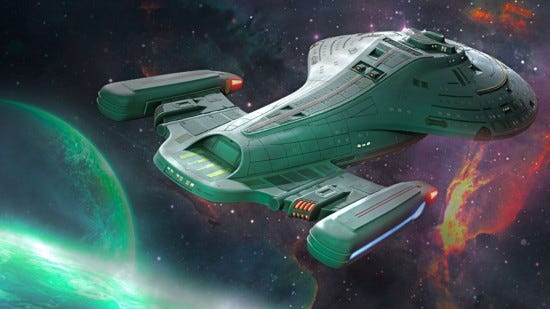
I do most of my reading in the mornings, and sometimes unwind from writing by playing video games. My usual preference, at least when I’m not looking for simple, dumb fun, is games that are stupidly intricate, incredibly hard, or some combination of both (if you’ve ever played a FromSoft title, you’ll get the idea). That way, I’m still forced to use my brain, and the fact I’m using it for something entirely pointless is, well, very much the point.
A few days ago I picked up a brand new game called Star Trek: Voyager – Across the Unknown (which comes by way of a Hamburg-based developer that seems to specialize in point-and-click adventure games). I really haven’t played anything like this since I was a kid playing Monkey Island in the early 2000s — and probably would have preferred to play something more flashy on a console had I owned one at the time. Across the Unknown isn’t purely point and click, and nor is it a purely text-based experience in the mould of stuff you might have gotten on floppy disk in the 1990s. Essentially, it’s an adventure/survival/rogue-lite game based on the TV series Star Trek Voyager (1995-2001).
If you never watched the show, its premise involves a starship that’s been stranded on the far side of the galaxy and is trying to make its way back to Earth. Voyager, distinct from other Trek settings, is a small science vessel: state-of-the-art but also cramped and forced to navigate vast and uncharted regions of space. For reasons that are probably too nerdy to get into here, there is also a major schism in the crew that creates the potential for mutiny and thus threatens to make the situation even more dangerous.
I enjoy Voyager, and in many ways (with apologies to Scott Bakula and Enterprise, a noble effort I enjoy as well) it’s the last Trek show to fully feel like Star Trek. But I’ve also always felt the show had some unfulfilled potential, and that — despite some great characters and solid episodes — ultimately failed to take its rather unique premise far enough.
In the first few seasons, it does often feel like the ship and crew are fighting for their very survival. But Kate Mulgrew’s Captain Janeway usually upholds the standard Starfleet morality and the crew’s basically ethical behaviour generally works out for the best. Among other things, this sometimes blunts the potentially interesting sense of danger and risk you’d want from a show with this premise. After Season 3, Voyager pivoted to what was arguably a darker and more brooding tone — among other things throwing the most terrifying of all Star Trek species (the Borg) into the mix. If nothing else, this did add a genuine sense of menace. The problem, though, was that it repeatedly forced the show’s writers to devise episodes in which a tiny science vessel was somehow able to thwart the most implacable and invincible of foes (often through an annoying deus ex machina attached to some technological gimmick).
The biggest problem of all, however, was that the show kept dangling potential ways that the ship and its crew might suddenly get home: a special, magical wormhole perhaps; a new kind of warp drive; a weird rift in space, etc etc. These, of course, never went anywhere because the show needed to continue and was fundamentally about being trapped in the most distant regions of space. As a result, many of Voyager’s most frustrating episodes are revolve around some supposed One Weird Trick that doesn’t ultimately work out.
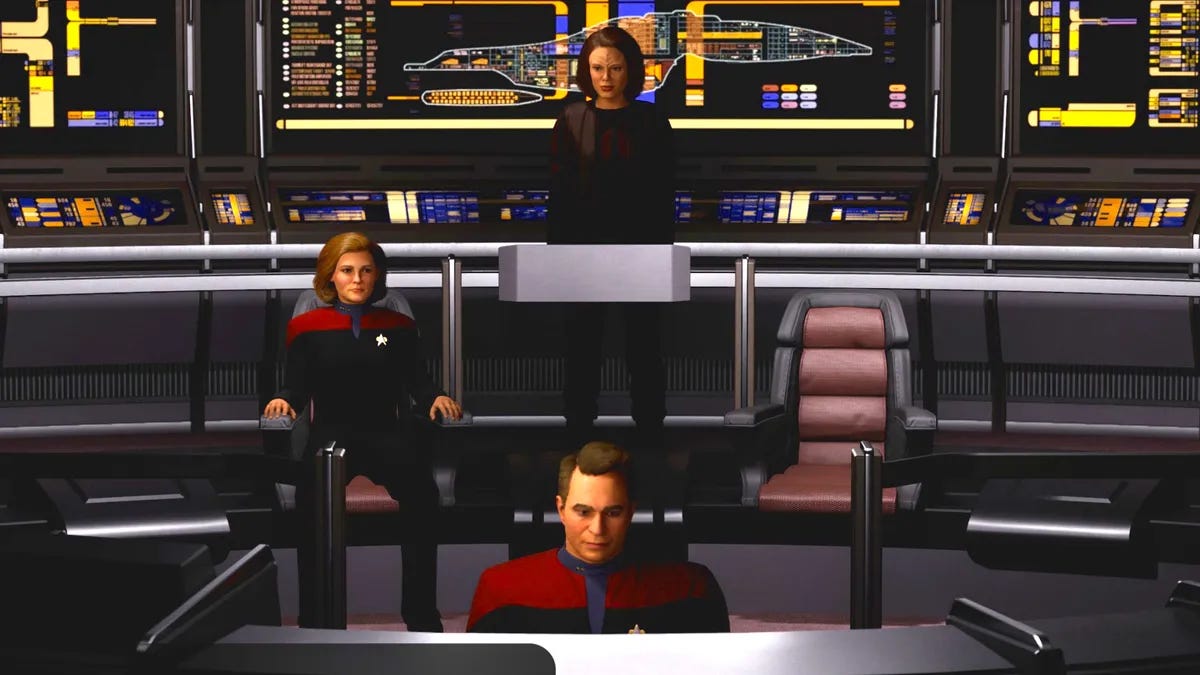
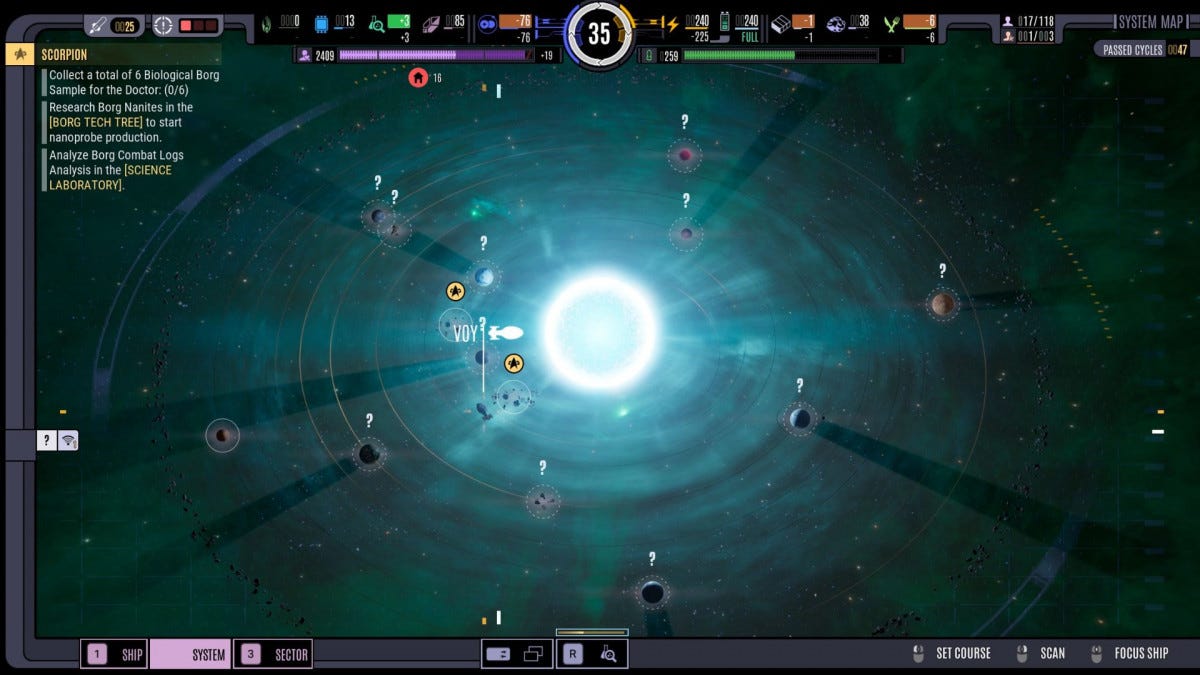
Across the Unknown definitely isn’t the most polished game. Among other things, there is limited voice acting and much of the dialogue is text only. The realtime ship to ship combat looks pretty cool, buts its mechanics are also pretty rudimentary: Voyager steers itself and your job is mostly to give broad commands about how to maneuver, what to shoot at, or when to fire a torpedo. The business of exploring systems, conducting away missions, and so on also isn’t very flashy. It’s mostly point and click, and you are forced to make choices that will either work out or get half the crew killed. The game’s narrative seems to roughly trace the narrative arc of the show (I’ve only played a few hours so far) but beyond its narrative-based tasks much of it is procedurally-generated, meaning there’s tons of room for random chance.
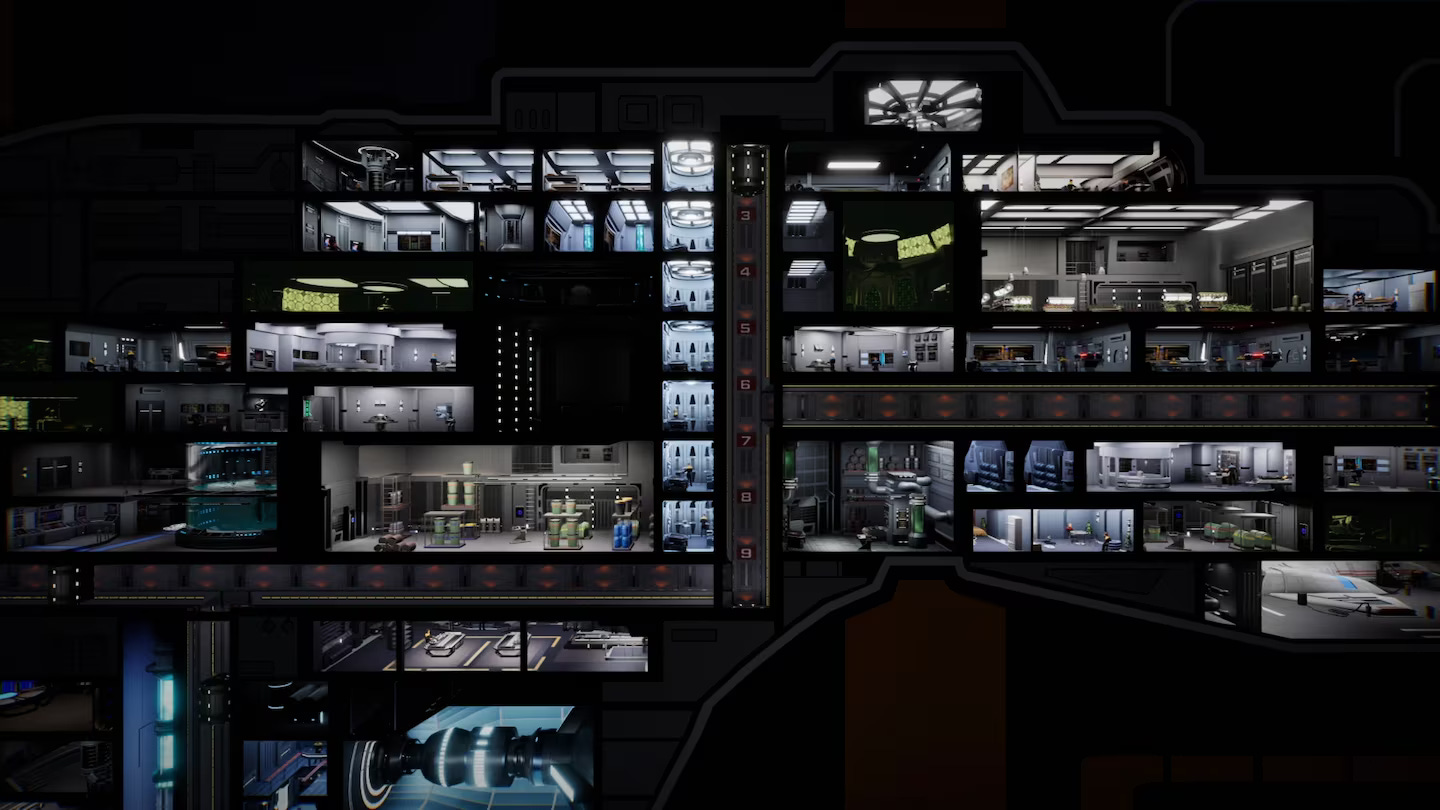
Where this game really really shines is in its ship and resource management systems. Its key interface shows you Voyager in profile, as something like an ant colony and with a POV reminiscent of one of Stephen Biesty’s Incredible Cross-Sections (hey, remember those?). The ship and its crew are a living ecosystem, and it’s your job to allocate resources, clear away and repair the many damaged areas you start the game with. You have to think about types of food, energy expenditure, what’s worth fixing or building, what to keep running and what to turn off. The interface (pictured below) isn’t static either. You can zoom right into individual rooms of the ship and what you do or don’t do effects what you’ll see there (for example, relaxed-looking, well-fed officers lounging in spacious quarters or exhausted crew at wit’s end in cramped, hastily-constructed cubbies). Again, there could be a bit more polish here. But it’s honestly pretty fucking great. The game’s mechanics are surprisingly sophisticated and the process of trying to figure out how exactly everything works while supplies are running low, the crew is mutinous, and hostile ships might attack you at any time is extremely challenging in the best sense.
The highest note of praise I have for this game, however, is that it somehow manages to stay firmly anchored in the show’s lore and plot while also introducing a real sense of risk and dread. If you mess up, overlook something, or face some sudden development beyond your control, major characters might die or the ship might quite literally be destroyed. And when this happens, it’s game over. There is no manual save function, so you can’t just go back to a few turns (or “cycles” in the game’s nomenclature) and try for a better outcome. To finish, you have to traverse twelve sectors — playing over three evenings I’ve only just made it to the fourth — and, if the ship is destroyed, the only saving grace is being able to start your current sector from the beginning (the game doesn’t make you start from the very beginning, in other words, but an individual sector can take many hours).
The upshot is that Across the Unknown ends up being pretty hard (I’ve died a few times already, and I haven’t even entered Borg space yet). There is a genuine sense of danger, precarity, and chance that the show itself so often lacked. You never really feel safe and there is always something to plan for or attend to. The game could use a few more bells and whistles, and with any luck the developers will be adding them through patches over the next few months (the away missions in particular are a definite weak point in my view). But I think some among the current crop of mixed or downright negative reviews are missing something here. Across the Unknown is basically The Oregon Trail meets Star Trek, with perhaps a dash of games like The Sims thrown in.
Among other things, it’s a satisfying and — in certain places — very well-crafted experience involving intricate systems, meticulous planning, and delicate resource management. More to the point, it’s also the punishing journey of risk and survival that the series itself too often failed to be.
Not really into video games (though I played the shit out of the Infocom titles, thanks for mentioning text). I'm slowly working my way through O'Brien's Aubrey and Maturin (Master and Commander) books, and the way he brings sailing to life is compelling. I'm naturally more of a Sci-fi reader when it comes to fiction, and your description of this game makes me realize that it might just be the similarities between life on the bounding main and that on the final frontier that made these books so enjoyable for me.