

.jpg)
Note: I keep as much of this Substack free as I can, but writing takes time and energy and if you’re able to subscribe here at one of the paid tiers and support my work you’d be doing me a solid. If you’re unable to afford a paid subscription, consider subscribing for free or send me a message and I’ll gladly comp your subscription.
I enjoyed Richard Evans’ Third Reich Trilogy so much that I periodically find myself returning to bits of it for no particular reason. Lately, I’ve been digging back into the first volume — in which the Nazis barely even feature until partway through. Evans instead begins his story in the 19th century and spends hundreds of pages carefully mapping all the various ideological and political currents in German society.
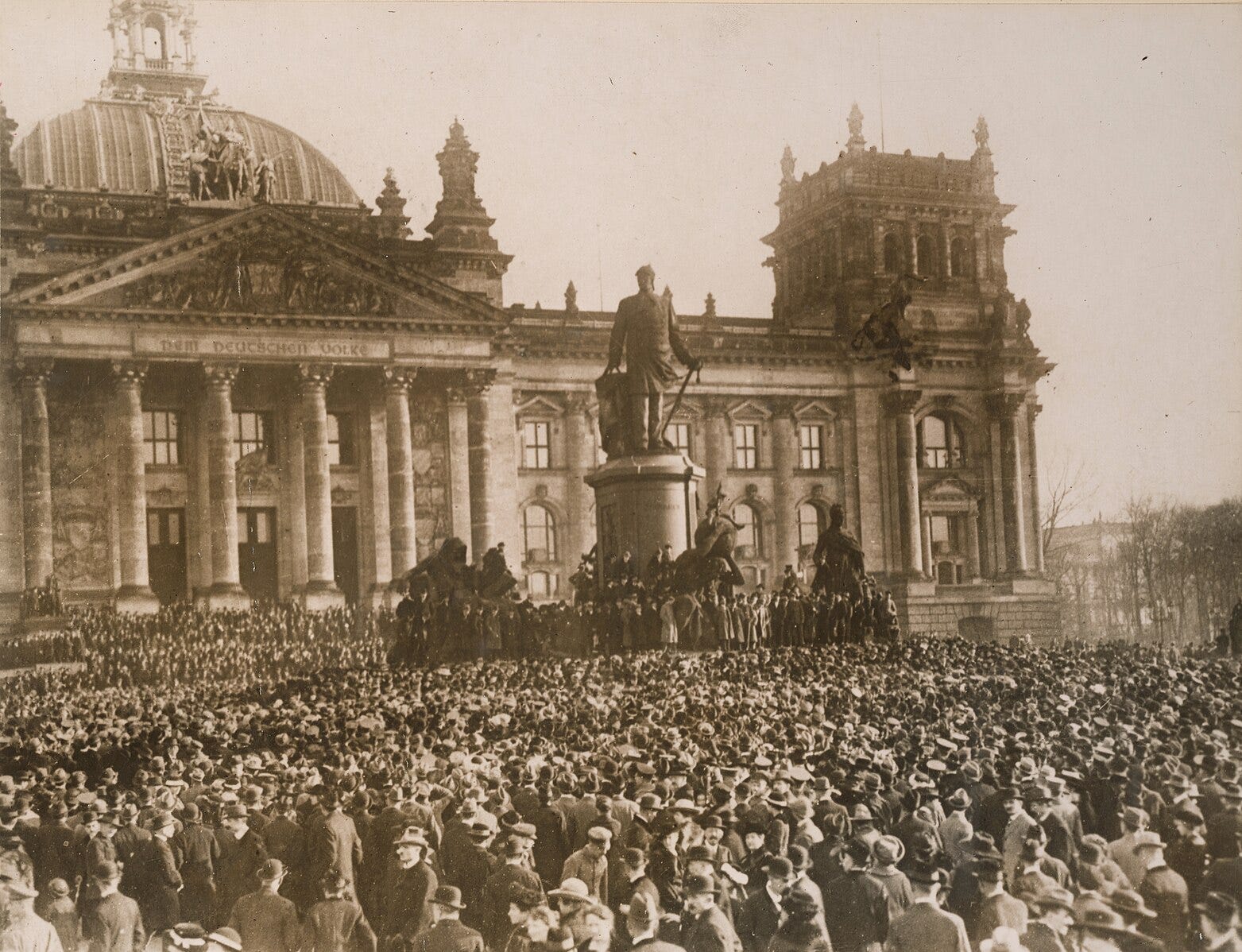
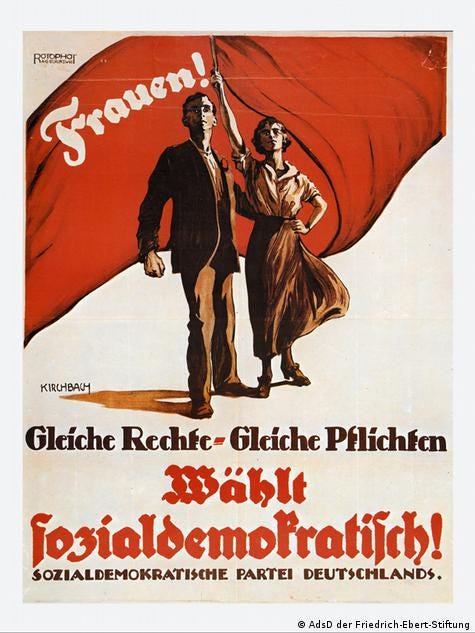
This is by no means an original point, but when you read about the mass politics of the Weimar period — or even of the Wilhelmine period that preceded it — it’s really striking how different they were from what people know as politics today. It wasn’t just that there were high levels of political participation (registered by vast rallies, high turnout in elections and so on). It was that the parties themselves were fundamentally social organs whose roots extended deep into civil society.
If you were, say, a social democrat or conservative nationalist, it’s likely you drank and socialized at specific pubs. When a member of your family passed away, the party itself might well have arranged and paid for their funeral. Political parties devoted considerable resources to political education, but also often provided for leisure and recreational activities as well. Had you sought out a pro-Kaiserite bowling league or rabbit hunting club in Saxony circa 1912, there’s a very good chance you would have found one. Much the same applied to churches, labour unions, women’s groups, and other organizations too. Associational life in general ran incredibly deep.
Among other things, this partly explains how the Nazis were able to build such a profoundly totalitarian regime once they’d seized power. When everything in civil society — from politics and education to social and recreational life — is so thoroughly institutionalized, taking over and disciplining (or banning) those institutions is going to be a very powerful lever. (This is also, by the way, one area where I think much of the new literature on authoritarianism is limited by its reliance on 20th century reference points, and the example of 1930s Germany in particular. Societies looked very different in the first half of the 20th century, so naturally the nature of authoritarianism was very different too).
But the main thing that’s come to mind in my current revisiting of The Coming of the Third Reich is the extent to which people today — even the politically engaged — have no real experience with, nor any real conception of mass politics at all.
During the first few decades of my own life — which is to say the 1990s and 2000s — we were in a largely post-political era. Parties and electoral politics still existed, of course, but political participation (as measured in a variety of ways) was generally very low. As I’ve written many times over the years, there was a profound poverty of political imagination as well, the only real grand narrative being that the age of grand narratives was over.
As Anton Jäger argues, this era of post-politics has increasingly given way to [what he’s usefully called] hyperpolitics, i.e. a “process of repoliticization without reinstitutionalization.” Since the 2010s there’s been a pervasive, and in many ways surprising, politicization of social and cultural life that makes the current era distinct from the politically sedate decades on either side of the millenium. But, crucially, this has largely played out in ad hoc fashion and in the absence of the kind of institutional forms that undergirded earlier kinds of political participation.
Again, I’m not building to some grand or original point here. But when you revisit the age of mass politics — in interwar Germany or anywhere else — it’s striking how profoundly alien it would now look to most people in the 21st century. Those of us who seek a revival of democratic mass politics would probably do well to keep this in mind. Because, should they suddenly become possible again, they will probably look very different and we will in a sense be starting from scratch.