
Last week, the Globe and Mail reported that a 40 year-old list of more than 700 suspected Nazis who settled in Canada after the Second World War will not be released. The office of Canada’s Information Commissioner told the paper risked “potential harm to international relations and Canadian interests”, which is probably another way of saying some of the names might be politically inconvenient.
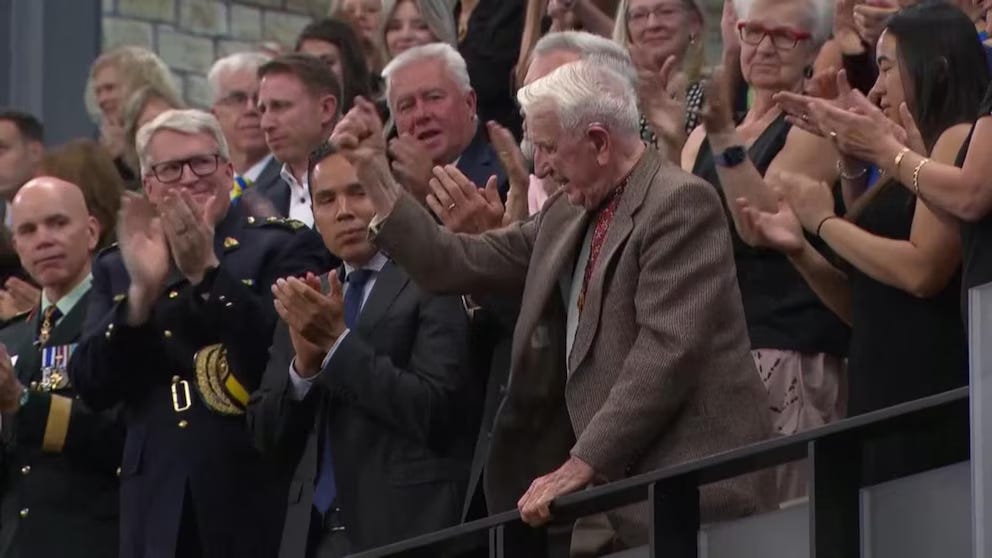
When Canada’s Parliament accidentally paid tribute to Waffen-SS veteran Yaroslav Hunka in 2023, it briefly drew attention to a genuinely sinister current of ultranationalism that successfully set down roots in Canada after 1945 — a fact expressed by the existence of endowments at major universities named after Ukrainian Nazis and monuments to them that remain standing today. As the BBC detailed three years ago:
One such monument sits in a private Ukrainian cemetery in Oakville, Ontario, and features the insignia of the Galicia Division. Another was put up by Ukrainian WWII veterans in Edmonton, Alberta. A third, also in Edmonton, depicts the bust of Roman Shukhevych, a Ukrainian nationalist leader and Nazi collaborator, whose units are accused of massacring Jews and Poles.
The so-called “Victims of Communism memorial” in Ottawa, meanwhile, finally went up with the planned names removed and you can probably imagine why.
What do you even say at this point? As a Canadian, I think it’s beyond shameful that our government refuses to confront or reckon with the existence of monuments to Nazis war criminals and what they represent. By doubling down on its refusal to release the names of those allowed to settle here after the war, Canada is effectively saying it’s in the interests of national security to shield the reputations of Nazis.
What follows was written in 2023 in the immediate aftermath of the Hunka affair, and I think its conclusion is just as relevant today.
A version of the following was originally published in Jacobin in 2023.
When word initially broke that the Canadian Parliament had offered a standing ovation for a ninety-eight-year old veteran of the Waffen-SS, it was disappointingly easy to imagine the story coming and going in a matter of days.
For one thing, previous reporting on monuments honouring veterans of the 14th Waffen Grenadier (or 1st Galician) Division had somehow failed to elicit any significant national outcry. After it was revealed in 2017 that Chrystia Freeland, then Canada’s foreign minister and now its minister of finance, knew of her grandfather Michael Chomiak’s past as the editor of a Nazi newspaper in occupied Poland, the story mostly seemed to fall on deaf ears — despite her having previously paid tribute to him.
And when Prime Minister Justin Trudeau invoked the spectre of “Russian disinformation” in the wake of the recent episode in Parliament, it was eerily plausible to imagine that the same might happen again. The grotesque spectacle of mainstream pundits prevaricating on the question of whether volunteering for the SS and swearing an oath of allegiance to Adolf Hitler technically made someone a Nazi only appeared to confirm the worst.
Whatever else can be said about the media discourse that has followed, however, the issue absolutely hasn’t gone away. In fact, Parliament’s feting of Yaroslav Hunka — who willingly joined a military unit that carried out war crimes and has continued to celebrate his membership in the SS into old age — seems to have punctured the silence. As Jeremy Appel speculated last month: “Perhaps the Hunka affair will serve as a catalyst for a long-overdue reckoning with how Canadian officials, in the name of anti-Communism, turned a blind eye to Nazi sympathies among eastern European nationalist émigrés . . .”
Thanks to the important work of Appel and a number of other journalists, details have continued to emerge about the appalling extent that expat Ukrainian Nazi collaborators insinuated themselves into Canada’s cultural and political life after the war. Hunka, as it turned out, actually had an endowment named for him at a major Alberta university. Since that was reported, nearly $1.5 million worth of similar endowments and donations have been identified. Peter Savaryn, who was fairly open about his past in the Waffen-SS, even served as chancellor of the University of Alberta in the 1980s and vice president of what was then the country’s national governing party. Upon retirement in 1987, he was awarded the Order of Canada, the country’s highest civilian honor. (This week, Canada’s current governor general Mary Simon issued an apology for the award.)
Jewish groups, meanwhile, are renewing calls for the removal of monuments to Ukrainians who fought for the Nazis currently standing in both Edmonton, Alberta, and Oakville, Ontario. Calls have also grown louder for the release of an unredacted version of the Deschenes Commission report — released following a flawed 1980s inquiry into the presence of Nazi war criminals in Canada, albeit with the names of alleged former Nazis kept secret.
Encouraging as these developments are, they have yet to stymie the steady flow of historical revisionism that has disgracefully followed the Hunka affair. Given the current geopolitical context, some appear to believe that the aggression of Vladimir Putin’s Russia against present-day Ukraine somehow justifies equivocation about the history of the Holocaust and criminality of Nazi-aligned Ukrainian collaborationists in the 1940s. Appalling pieces like this one, published by no less than Politico, have gone even further in suggesting that the demonology of the Waffen-SS — which was officially declared a criminal organization by the International Military Tribunal during the Nuremberg Trials — is somehow misplaced.
It’s alarming that this even needs to be said, but it’s beyond sinister to see people parroting far-right nationalist propaganda under the guise of resisting “disinformation.” It moreover does a deep disservice, not only to history, but also to the heroic efforts of the millions of Ukrainians in the Red Army who helped defeat Nazi Germany and to all those in Canada’s Ukrainian diaspora who reject the nationalist right’s attempts to rewrite it.
Whatever ultimately comes out of it, the disgraceful Hunka episode has helped expose something deeply ugly in Canada’s history, and the extent that some are willing to go to bend the past around their preferred contemporary narrative. With any luck, however, this is only the beginning. The statues must come down. The endowments must be identified and terminated. The records must be opened up. And the veil of ignorance some have tried to place over the history of the twentieth century must be lifted for good.
I researched the issue of Nazis being allowed into Canada in the 1980s. That resulted in an article being published in the Journal of Canadian Studies in Fall, 1986, entitled "Canadian Immigration Policy and the Cold War, 1945-1980." Life was made easy by a sympathetic archivist at what's now Library and Archives Canada. Among other things, I was able to get figures for successful appeals to the Department of Immigration for those rejected by the RCMP for their Nazi connections. Half the people rejected in 1950-1 as voluntary participants in the armed forces and SS appealed their rejection and the minister and his officials overturned 65 percent of them. 95% of those rejected for connections with the Nazi party were successful in their appeals. William Kelly, the RCMP officer-in-charge of security screening of prospective immigrants wrote a forceful memo to his superior in 1953 accusing the government of treating members of the SS, SD, and the Waffen-SS, the latter being the guards of senior Nazi party officials, as if their participation was involuntary when in fact they should be treated as war criminals. Meanwhile, the government was obsessively diligent in preventing those deemed potential Communist sympathizers from even visiting Canada, never mind becoming immigrants. Italians with any potential connection to either that country's Communist or Socialist Party or unions were automatically ineligible to come to Canada whereas there were no restrictions on members at any level of the MSI, the reconstructed Fascist Party of Benito Mussolini. I sent a piece to The Globe and Mail in 1986 based on my research and received a note claiming that they had already covered that issue, which was a lie. Southam newspapers were also unwilling to publish a piece that I sent them. In 2023, after the Hunka affair, I tried again with the Toronto Star, which didn't even bother to respond. By contrast, The Tyee and Active History did publish a piece that I wrote about immigration policy in the 1950s, beginning with the government's reversal in early 1950 on the issue of allowing the large group of members of the First Ukrainian Division of the German army into Canada. They had been held in detention in Britain for five years at that point.
It was more than that, military and intelligence have stated on more than once it was closer to2000. They came to the perfect place, Canada has had a soft spot for nazi. They have a Nazi Camp for youth 11-17 ,you know to hone their skills. Statues in AB and ON honouring Freelands Banderas roots, one beside a Ukranian youth Centre. It’s not hidden just no one looks. When the Youth Camp was reported, the police said they couldn’t do anything about it, they were a legitimate party