

In light of strong interest, I’ve decided to extend last month’s discounted subscription offer. Until the end of April, that means you take out a full year’s subscription for just 50% the regular cost. To subscribe at the discounted rate and support my work you can click here or alternatively subscribe for free and still get the regular free posts sent right to your inbox. NOTE: A version of the following was originally published in Jacobin in 2023.
Last year, the Daily Wire’s Ben Shapiro debated Tucker Carlson on the question of automation. Ventriloquizing a familiar market-conservative argument, Shapiro asked his guest point-blank whether he would support restrictions on the use of technology in order to protect jobs. In his reply, Carlson was nothing short of incredulous.
Shapiro: You talk in [your] book about technology and how it’s shifting and taking away jobs from folks, and you make specific reference to truck driving and the fact that there are going to be these automated cars on the roads. So would you, Tucker Carlson, be in favour of restrictions on the ability of trucking companies to use this sort of technology specifically to, sort of, artificially maintain the number of jobs that are available in the trucking industry?
Carlson: Are you joking? In a second. In a second. In other words, if I were president, would I say to the Department of Transportation, “We’re not letting driverless trucks on the road, period”? Why? Really simple. Driving for a living is the single most common job for high school–educated men in this country.
In this answer, there’s a hint at where Carlson’s argument is ultimately rooted. For him and other social conservatives, the question of automation is primarily about the stability of the patriarchal family unit, with the male breadwinner at its centre. As far as his prescriptions, Carlson even went as far as saying that the government should contrive a phony pretext for banning self-driving trucks altogether.
There is, of course, a third option that neither Shapiro’s market dogmatism nor Carlson’s reactionary luddism was willing to entertain. As conservatives, both clearly see some inherent good in people having to work. The former might favour the “creative destruction” wrought by markets and the latter certain restrictions on them, but neither views technology as a potentially liberatory tool for workers.
In the nineteenth and early twentieth centuries, people simply took it for granted that technological progress would eventually give rise to a leisure society in which people, freed from the necessity of toil, would have all the time in the world to pursue and nurture their interests as they saw fit. Over the last hundred years, however, only one half of this prophecy has been borne out. Technological progress has been unprecedented, making production more efficient and all kinds of difficult tasks less arduous. Between 1950 and 2020, the United States experienced a 299 percent increase in labour productivity, and jobs of all kinds became safer and easier.
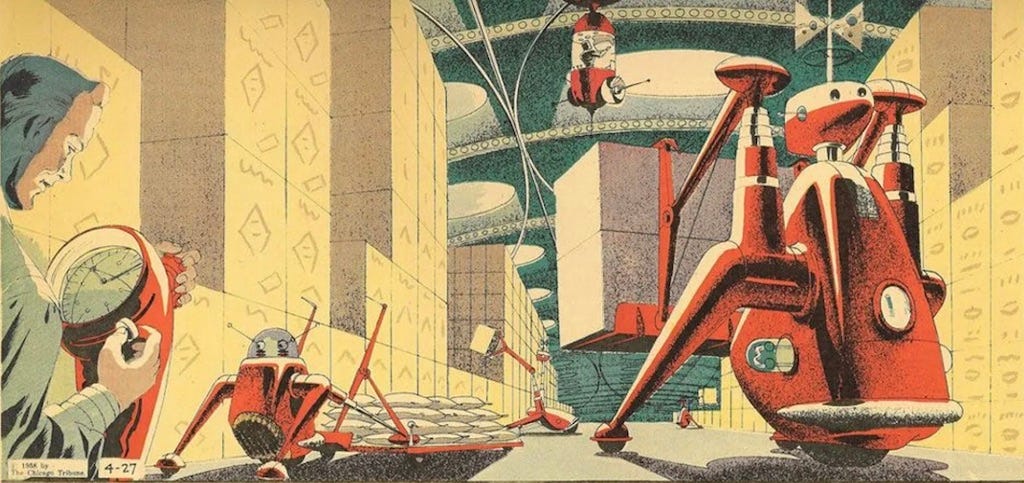
At the same time, many were eliminated — and with them the livelihoods they once sustained. Better telecommunications technology, after all, means you don’t need switchboard operators. Self-checkout units reduce opportunities in retail employment. Aided by machines, factories can now produce more with fewer workers involved. With the advent of AI technologies and self-driving vehicles, the same process will only unfold at an accelerated pace in the decades ahead.
This is hardly an original thought, but the social consequences are pretty alarming to contemplate. Despite being more productive than ever, workers’ wages have long been stagnant, and punishingly long working hours are already causing a needless seven hundred thousand deaths per year, according to the International Labour Organization. As millions more jobs are eliminated and service work in particular becomes more precarious, a process that could — and should — benefit workers will instead be one that makes their lives more difficult and insecure.
That the current political climate precludes potential solutions to this problem doesn’t make those solutions any less obvious. Modernization presents a clear opportunity to legislate shorter working weeks — something for which there is already historical precedent. As Bernie Sanders put it recently: “In 1940, the Fair Labor Standards Act reduced the workweek to 40 hours. Today, as a result of huge advances in technology and productivity, now is the time to lower the workweek to 32 hours — with no loss in pay.” (Iceland’s experiment to this effect, incidentally, has already yielded great results, which you can read about here in my 2021 discussion with researcher Guðmundur D. Haraldsson.)
During a recent interview with CBS’s Margaret Brennan, Sanders also raised the prospect of a robot tax that would compel companies to pay a premium for replacing workers. Though the idea remains underdeveloped at the level of detail, it’s one that’s been floating around in various forms since the 1980s as a potential response to automation and could help generate the revenue needed to fund new public goods and universal services.
In the end, it’s ultimately these that represent the best solution to the problems posed by automation. Despite what some on the reactionary right might insist, there is no need to artificially limit technology in order to preserve jobs that can be performed by machines. With high-quality, universal services in place and an economy structured around the imperatives of social need rather than those of private profit, the importance of work in daily life would dramatically recede. Freed from the constant grind of tedious and unnecessary labor, countless millions would instead be able to spend their time however they chose without having to grind and struggle just to obtain bare subsistence. This, in some ways more than anything else, has always been the fundamental goal and basic objective of socialism. As Chris Maisano writes:
The one-sided focus of most Marxists and socialists on distributional questions has obscured the fact that the animating principle of the Left is not so much equality, but rather freedom — freedom from alienating work and freedom to use our time and creativity for our own self-directed ends. Socialism does not equal the roughly equal distribution of stuff; the martyrs of the labour movement didn’t give up their lives so that everyone could have the right to buy an iPhone or a plasma screen TV, or to waste their lives working at crap jobs…So long as the Left does not seek to fundamentally alter the labor process nor shorten the working day to the least amount of time possible, it fails to act on what should be its most fundamental principles.
Here, we are hardly grasping for some utopia. The socialist project, in spite of what its critics might say, isn’t striving for a society without problems. Instead, to borrow from Freud (by way of Corey Robin), socialists seek a future in which hysterical misery has been transformed into ordinary unhappiness.
Unless you’re wedded to retrograde ideas about work, gender, and the family, there is no reason not to welcome such a future with open arms.
Great article Luke. I think the fundamental failure of, especially neo-liberal, capitalists is the utter inability to treat the economic world as a social system for the distribution of goods, wealth and the means of social reproduction. Instead modern free-market economists treat the economy and much of economic theory like it were the environment, and they were merely meteorologists diagnosing why the weather does what it does, and what subtle changes we can make to how it will effect us.
As long as our power elite continue to insist on the natural-ness of free-market neoliberal capitalism we will continue to deal with this contradiction, and watch as we fall further and further from a progressive utopia even as the means for its production come closer and closer.
Ivan Illich in his books of the 1970s like Tools for Conviviality and E.F. Schumacher 's Small is Beautiful focus on tools that free us- serve us. Greater equality is a by product of freeing us radically from what holds us traps us said Rousseau.