

Note: I keep as much of this Substack free as I can, but writing takes time and energy and if you’re able to subscribe here at one of the paid tiers and support my work you’d be doing me a solid. If you’re unable to afford a paid subscription, consider subscribing for free or send me a message and I’ll gladly comp your subscription.
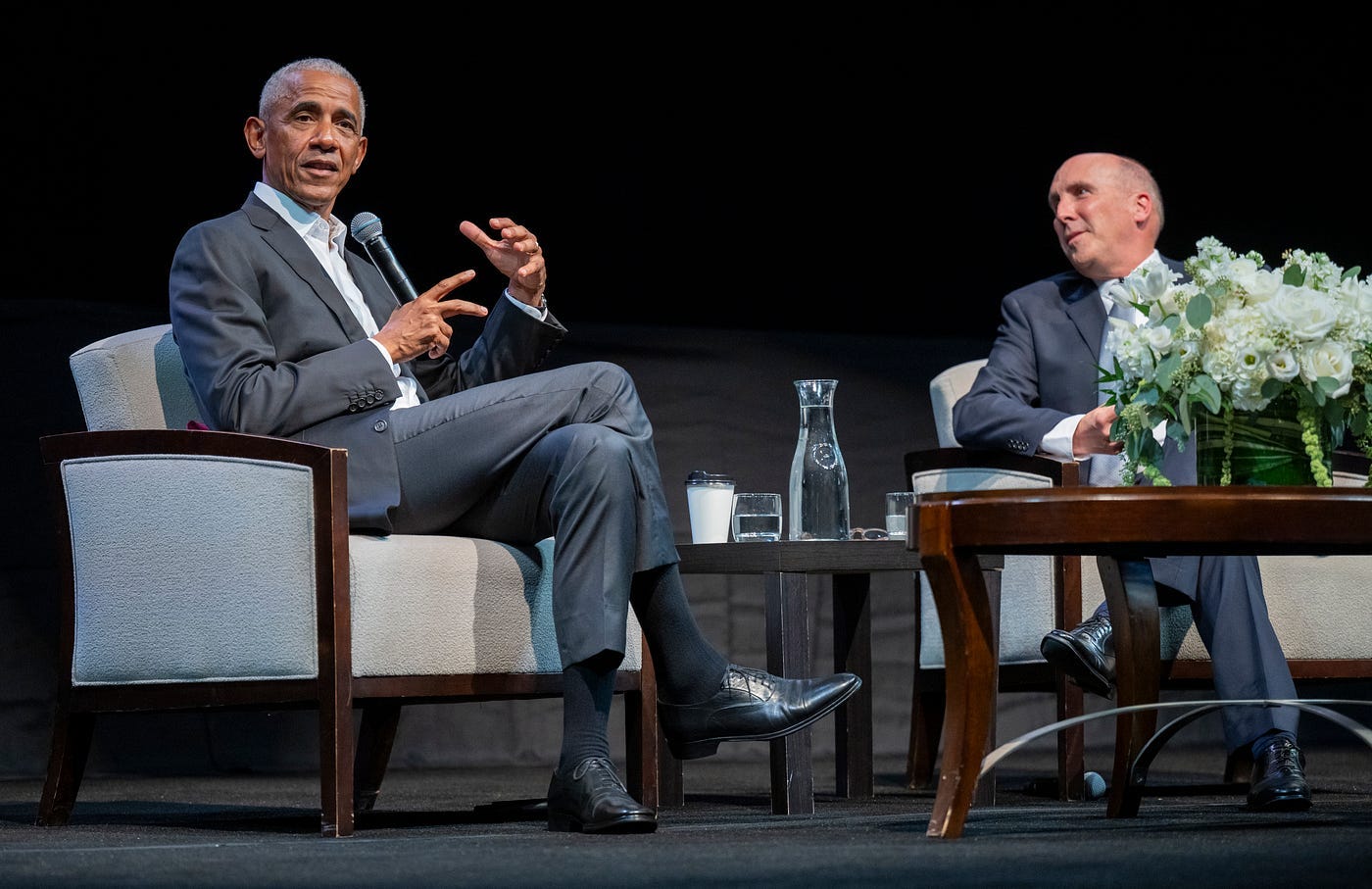
Speaking recently at a forum hosted by Colgate University, Barack Obama offered the following assessment of where America’s liberals have erred:
What people are starved for at the moment is the ability to tell a moral and ethical story about how we live together in this moment. And I think one of the mistakes that Democrats and some on the left have made for awhile was making everything mechanical and instrumental and materialistic about tax policy and earned income tax credits. All that stuff is important. But there is an underlying moral foundation to how do we see each other and treat each other that so often came out of the church or the temple or the synagogue or the mosque…Not everyone participates in organized religion in the same ways but the essential questions…our leaders have to be able to speak that language in a serious way, in an earnest way."
The bolded section, for obvious reasons, has been making the rounds in a viral clip — widely eliciting the just-as-obvious rejoinders (as one representative comment reads: “look i love obama but this is just incredibly emblematic of the different realities and spheres of understanding that wealthy people live in compared to almost everyone else”). Obama, in fact, has issued periodic salvos against materialism (see here), which is, well, more than a little rich coming from someone who has devoted so much of his post-presidential life to the enterprise of becoming fabulously wealthy. As the New Yorker’s Ishaan Tharoor points out, Obama’s argument is also somewhat puzzling even on its own terms given the extent to which Democrats have chosen to tell an abstract story about the soul of the republic in place of any more tangible offer to voters.


More substantively, though, Obama’s remark seems emblematic of a tic we’ve seen again and again from America’s centrist liberals: namely, the blinkered belief that the challenges confronting liberalism today are primarily problems of narrative and storytelling; something concerned with comms, messaging, and aesthetics rather than policy, program, or ideology. That, among other things, is the register through which politics is mostly framed and discussed on popular liberal shows like Pod Save America. It’s similarly appeared in plenty of shallow campaign postmortems and been the cri de cœur of many a failed primary campaign.
The basic contours of the Democratic platform itself have barely shifted since 2016 (arguably before) and the stuff that is new is largely about reverting various things to their pre-Trump status quo. On the other hand, vast empires of discourse and meta-narrative have risen and fallen: “moral capitalism” (why hasn’t someone thought of that?), Popularism, Nudging, Abundance/Supply side liberalism, most of them a variation or friendly amendment to the so-called Third Way — whose basic assumptions much of America’s liberal braintrust has stubbornly refused to revise since adopting them in the 1990s.
Incidentally, I have a story of mine own to offer here.
In the 1990s, the first Democratic president elected since Jimmy Carter finished Reagan’s work by gutting whatever remained of the New Deal: pursuing a trade agenda that destroyed manufacturing jobs and laid waste to vast segments the country while relieving high finance of regulatory guardrails and transforming America’s economy — and its housing market in particular — into one giant casino. When the bubble inevitably burst, the next Democratic president was swept into power with a mandate to pursue sweeping change but chose instead to shower banks and major financial institutions in cash while the middle class was left to drown. By the time he left office, the legitimacy of America’s political class was so thoroughly eroded that a mercurial reality show host could be elected president simply by giving it the middle finger.
Ten years, and one Democratic presidential term later, millions of Americans are struggling like never before and economic inequality has reached levels not seen since the Gilded Age. In the wealthiest society on earth, even the most basic financial security is increasingly viewed as a luxury and stable employment a thing of the past.
I would humbly suggest, therefore, that the issue here is not some vaguely defined spiritual crisis nor about the inability of the liberal leadership class to unite people around a shared moral narrative. In our secular age, the most successful vehicle of social solidarity has been mass democratic politics: not as an end in itself but as a means for winning the kinds of universal rights and public goods that make authentic community possible while allowing individuals to flourish.
Ordinary Americans, really and truly, are not pining to hear a more compelling story about the public squalor and economic dysfunction they are compelled to live with every day. What they need is universal healthcare, affordable housing, and an education system that doesn’t drown them with debt. They need free transit, bountiful jobs, real representation at work and a government that doesn’t funnel trillions into the military-industrial complex. They need an economy where finance and commerce are properly regulated and the behaviour of most politicians isn’t dictated by the whims of plutocratic campaign donors.
What they categorically do not need is another cozy fable whose only real aspiration is to sooth them amid the rot.
Absolutely. "Ordinary Americans, really and truly, are not pining to hear a more compelling story about the public squalor and economic dysfunction they are compelled to live with every day. What they need is universal healthcare, affordable housing, and an education system that doesn’t drown them with debt." Ask Zohran Mamdani.