

Note: For the next two weeks, I’m offering heavily discounted subscriptions. Click here to get a full year’s access to all paywalled content, including everything in the archives, for 50% off. If you’re unable to afford a paid subscription, consider subscribing for free or send me a message and I’ll gladly comp your subscription.
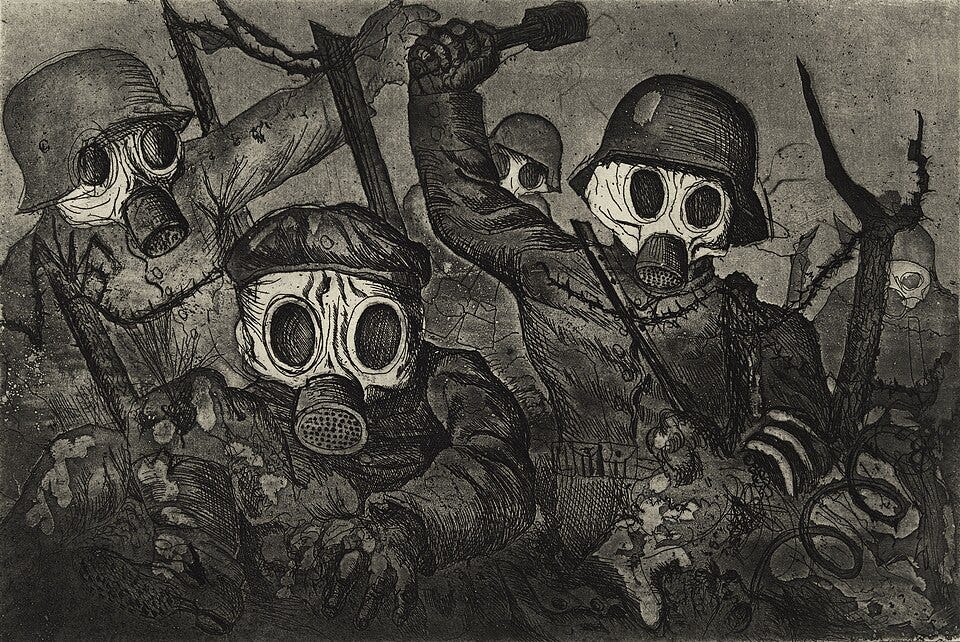
Last year, I finally got around to reading All Quiet on the Western Front, Erich Maria Remarque’s remarkable novel about the horrors of trench warfare. Because I grew up in Canada and am of British heritage, the book’s perspective — reflecting the author’s own experience as an infantryman in the German Imperial Army — was in one sense new to me. When it came Remarque’s portrait of trench warfare itself, however, I was immediately struck by how familiar it seemed.
Going back to grade school, the image of the trench — wet, rank, filthy, inextricably linked to a kind of modern mechanized warfare defined by futility and stalemate — has, for me at least, been the thing most synonymous with the First World War. I suspect imagine the same is true if you grew up in Britain or France, and trench warfare is absolutely central to all the popular depictions I can think of (the poetry of Wilfred Owen, Stanley Kubrick’s Paths of Glory, and the fourth season of Blackadder all come to mind).
Anyway, it dawned on me that I was never taught about the Eastern Front at all and, in fact, barely knew anything about it until my twenties. Considering the scale of the war in the east, this was a pretty glaring omission. And it’s all the more striking because what soldiers and civilians alike experienced there was completely different from what they experienced in the west. In the east, the frontline was far less static. Trenches were absolutely used but, among other things, the vast landmass of central and eastern Europe meant it was much easier for the various armies to manoeuvre — making it logistically impossible for them to deploy continuous trenches like the kind used in Belgium and France.
Since I first learned about the war in elementary school, I’ve had plenty of time to read about major Eastern Front battles like Tannenberg. And yet, to this day, I still cannot really visualize them because my brain still stubbornly thinks of trenches. I have no idea how the war is remembered or taught in Germany these days, but doubtless some attention is paid to the Eastern Front as well as depictions like Remarque’s. (Ernst Jünger had worse politics but I expect many German high school students have at least some familiarity with Storm of Steel too).
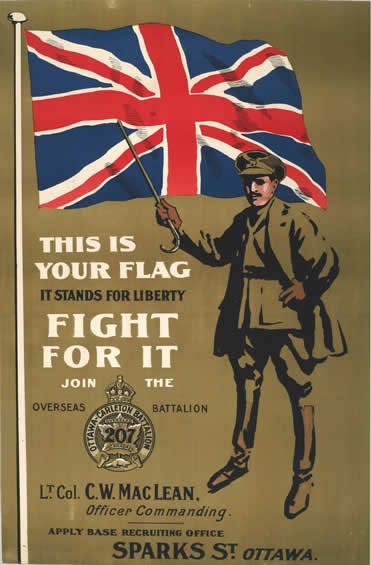
It’s inevitable, I suppose, that public memory of the war is shaped by what the populations of different countries experienced between 1914 and 1918. Just as I learned about the likes of Billy Bishop and Vimy Ridge, I’m sure New Zealanders, Australians, and Turks (for example) learn heavily about the Dardanelles campaigns. If you’ve been educated in Russia — under any regime since the fall of the Tsar — your thinking about the war is probably going to be interwoven with the 1917 and 1919 revolutions. And so on and so on.
Still, I cannot quite shake the fact that the war in the east remains partly invisible to me even after reading about it and, among other things, it seems a good illustration of how much your location and upbringing can shape your perception of major historical events. Considering how much time has now passed, it’s hard not to see the hand of nationalist parochialism at work. And given the extent to which that very thing was responsible for sending a whole generation of European men — British, French, German, Austro-Hungarian, Bulgarian, Russian, Italian, Turkish — into four years of unconscionable mass slaughter, this should not sit well with any of us more than a century later.