

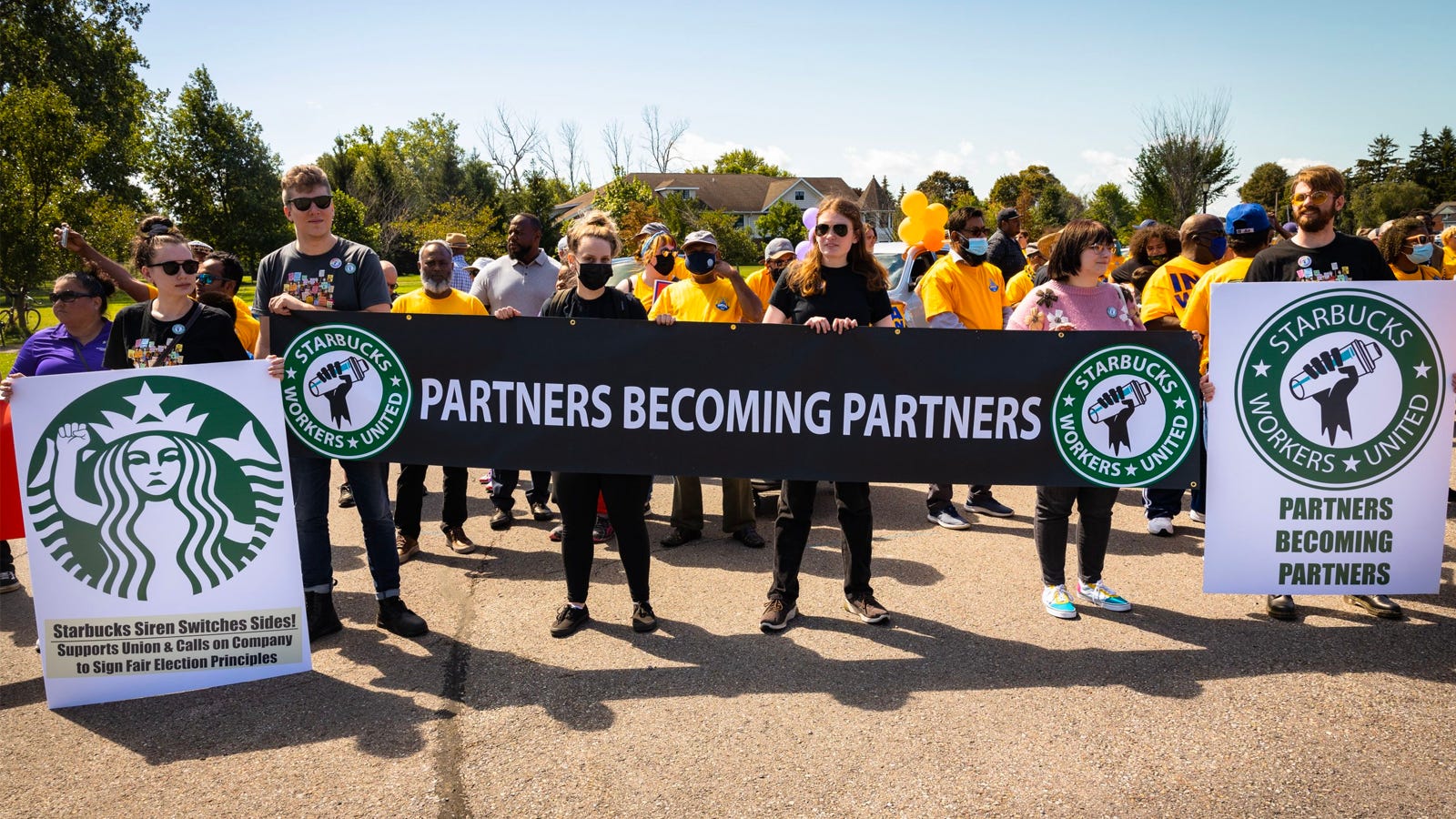
Learn more about how you can support striking Starbucks workers and their union here: https://sbworkersunited.org/take-action/
In my late teens I spent about a year and a half working as a line cook. It beat telemarketing (my first gig out of high school) but it was both physically and mentally gruelling and minor injuries like cuts and oil burns inevitably came with the territory. The hours were long, the pay was absolutely terrible — the minimum wage at the time was $7.75 Canadian — and the pace was completely exhausting. Lunch and dinner rushes were usually the worst, but it also wasn’t uncommon for ravenous parties of 8-10 to show up after midnight in search of fries or nachos.
The actual business of cooking aside, tremendous skill and efficiency were required to get everything prepped and ready in the right quantities at the right time. Knowing how to make everything on the menu was part of it, but successfully combining Fordist regimentation and proper presentation (I didn’t work in fine dining but it was a somewhat upscale place with a demanding, well-heeled clientele) was a complicated thing you could only learn by doing. All of which is to say: no amount of verbal description of recipes and their related tasks could ever have adequately prepared someone to do the job — a reality instantly confirmed on the rare occasions the restaurant’s quietly authoritarian floor manager would sub-in for someone on the line.
They’d often make small mistakes in the recipes (no green onion with that salad, bread cut in the wrong shape for that sandwich, etc.) But the real problem was that they had no experience with all of the tiny rituals and informal methods the full-time kitchen staff had been compelled to devise to get through a shift. I won’t even start on the owners, who worked considerably less, made a king’s ransom compared to the rest of us, and often seemed quite aloof when it came to the everyday workings of their own establishment. Had it not been for the talent of the head chef, and the collective efforts of the kitchen and wait staff, pretty much nothing would have worked.
All this came to mind thanks to an excellent recent video from More Perfect Union about Starbucks. At time of writing, thousands of Starbucks workers are still on strike for all the familiar reasons. This is a chain that calls its chronically overworked and criminally underpaid baristas “partners” but stubbornly refuses to recognize their right to join a union. But it’s also one, as the video documents, whose dogmatic opposition to workplace democracy and obsessive preoccupation with shareholder value have become increasingly self-defeating.
Over the past several years, Starbucks has greedily raised its prices while steadily reducing the quality of its service. It no longer offers free water or bathroom access (you now need a code to access a Starbucks bathroom and the management apparently requires staff to change it every change day) and executives have incessantly imposed clunky new workplace systems on baristas that only make their jobs harder. Its cafes, meanwhile, have been deliberately transformed into less pleasant and welcoming spaces: spaces you’d be lucky to find a seat in and probably wouldn’t want to linger in even if one happened to be available.
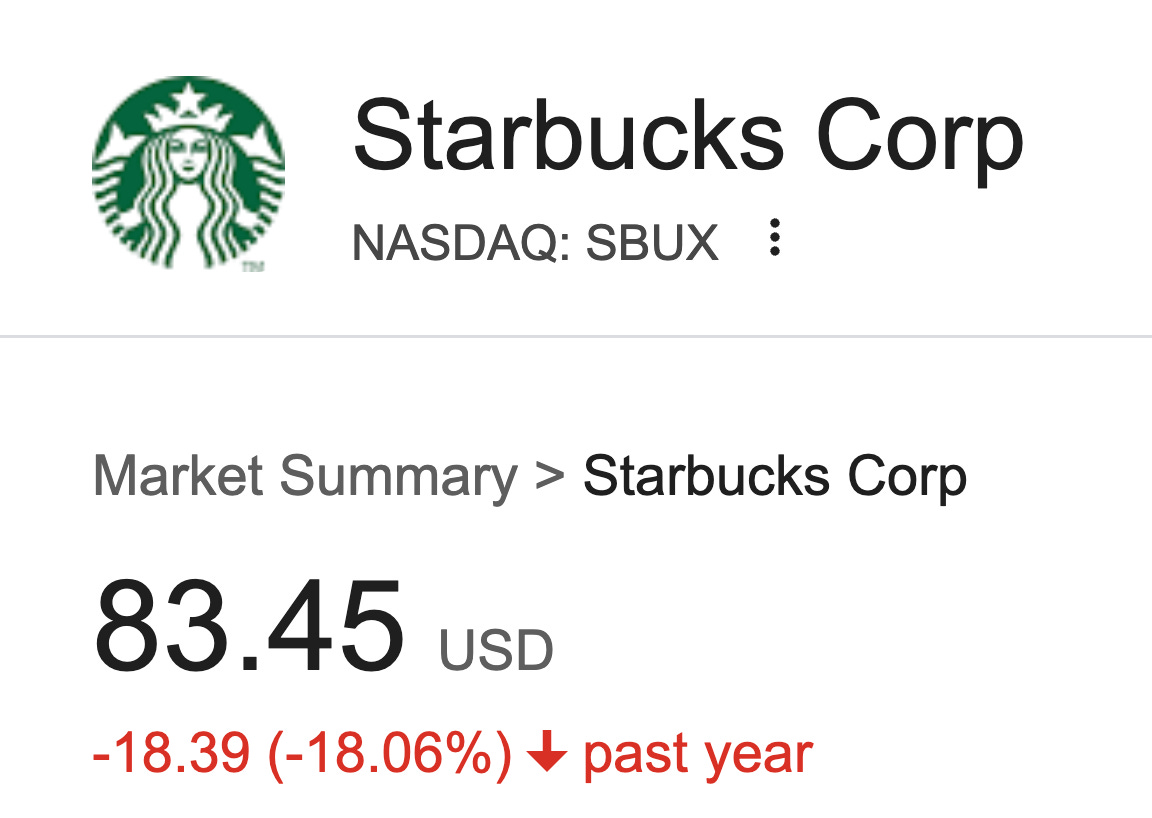
All this seems apiece with the broader trend of enshittification we’ve witnessed over the past several years in which many things that once worked reasonably well — be they apps, social media platforms, or Seattle-based coffee chains — have been intentionally made worse by the profiteers who run them to quite predictable results. In keeping with this trend, Starbucks’ share price has recently taken a nosedive. Evidently, poorer quality, higher prices, and open hostility to its own workers have turned off customers without achieving the returns presumably anticipated by executives.
Something that particularly struck me from the testimonies of Starbucks workers themselves found here is how visibly frustrated many are by the company’s bad management decisions. However anti-union propagandists might spin things to the contrary, these are people who care deeply about their work and want the cafes they staff to be well-run spaces that are enjoyable to be in and serve good coffee. We know this because so many thousands have responded to Starbucks’ union-busting efforts by opting to stay and fight rather than pursue the path of least resistance and look for work elsewhere.
As the people actually tasked with running the company’s cafes and drive-thrus, they know full well how its service could be improved — if only management would extend them basic respect. Ironically, given how hard executives are resisting it, increased worker control would probably be good for shareholders. Silvia Baldwin, a barista from Philadelphia, puts this especially well in the short documentary above:
Our union is a godsend to this company that has been in crisis, that is losing customers. And here we have this incredibly motivated group of 12,000 plus workers who are saying ‘We know exactly what it’s going to take to make this company work.’
There many problems with the corporate model on which a company like Starbucks is based, not least that its default setting is to siphon the lion’s share of profit to people who own expensive bits of paper rather than those whose work makes it run. But, in this case especially, the obsessive privileging of shareholder returns at the expense of all else makes even the relatively straightforward business of making and serving coffee irrational and inefficient. If even a single Starbucks cafes was transformed into a worker-run co-op, I expect it would instantly outperform the others according to every metric that matters.
Running a large firm or enterprise is always going to be a complex task, and even a worker-owned multinational would presumably need a management hierarchy of some kind. But there is simply no getting around the fact that the people who perform the most nuts and bolts work at a store, cafe, restaurant, or factory will almost invariably know how to do it best.
Democracy is a good thing in and of itself, but it can often have straightforward instrumental value as well. If nothing else, a rational economic model striving for both fairness and efficiency would give basic recognition to that fact.
I went to a picket line a few weeks ago and I was interested in hearing how several people said that it was never perfect working there, but during Covid things took a nosedive. Looking back at Covid in general, for the businesses that could stay open it was sort of a dream situation. A world where the customers and workers came in and out. Nobody is allowed to linger, capitalism without the humans.
Supported and stood in line with the Starbucks workers picketing on strike here in Memphis, TN! They are organized and truly the most experienced, knowledgeable, and ready to take rightful cooperative ownership of this struggling corporate business!